

The right product here depends on your site. We confirm it before naming it.
Step-by-step solution
Structural cracks in beams, columns & slabs
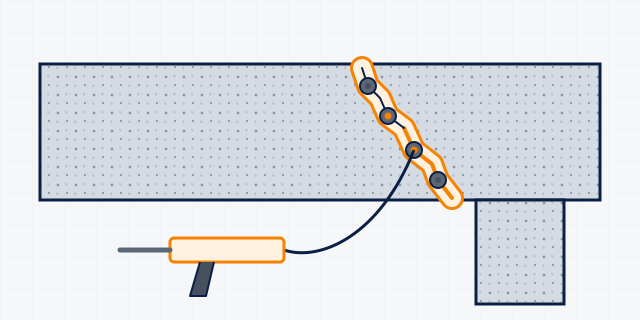
Cracks in load-bearing members can come from overload, settlement, corrosion or design faults, so an engineer must find the cause first. Dry or damp cracks are then bonded by epoxy injection; leaking cracks follow the leaking-cracks guide.
- 7 steps
- 4 products
- 4 answers
You need this when…
- Cracks across beams or columns, or diagonal cracks near supports
- Slab soffit cracks that grow longer or wider
- Cracks together with sagging floors or doors that stick
- Cracks that reopen after plastering
- Cracks at beam-column joints after an earthquake
The work, step by step
General guidance based on the manufacturer data sheets. Site conditions differ: confirm the system with MCT before you start. Where we do not name a product, ask us and we will confirm the right one.
-
Step 1: Engineer's assessment
A structural engineer must assess the cause, whether the crack is still moving, and whether repair or strengthening is needed; structural applications need an engineer's design (Sikadur-32 LP p.3). Record width, length, location and whether the crack is dry, damp or wet.
-
Step 2: Prepare the crack
Clean the surface by high-pressure water jetting or grinding and blow dust out of the crack with compressed air (Sikadur-52 LP p.3). Fix injection ports and seal the crack face between them; Sikadur-31 DW is a non-sag epoxy for crack arris and edge sealing (Sikadur-31 DW p.1). Professionals only (p.1).
Product for this stepAsk us -
Step 3: Inject dry or damp cracks with epoxy
Sikadur-52 LP is a low-viscosity epoxy that structurally bonds concrete sections together (Sikadur-52 LP p.1). Dry or damp cracks only, not wet; over 5 mm wide, ask us (p.2). Substrate +25 °C to +40 °C (p.2). On slabs, cracks can be gravity-filled between sealant dams; cracks through to the soffit are sealed underneath first (p.3).
Sikadur-52 LP Sika Request a quotation Injection resin with good adhesion to concrete, mortar, stone, steel, and wood. (TDS p.1)
- Temperature stated in TDS
- +25 °C min. / +40 °C max (TDS p.2)
-
Step 4: Cementitious option where steel is corroding
Sika InjectoCem-190 is a microcement grout for structural grouting of cracks that also protects corroding reinforcement (InjectoCem-190 p.1). Inject from bottom to top at 3–8 bar and pre-wet dry concrete (p.2).
Sika InjectoCem-190 Sika Request a quotation Injection of Sika® Injectoflex® Systems Typ DI-1 and SikaFuko® injection hoses Filling of voids Final, rigid, cementitious sealing of cracks while simultaneously treating corroding or corrosion-prone reinforcing steel in concrete and mortar (TDS p.1)
-
Step 5: Leaking cracks take a different route
If water is flowing through, use the leaking-cracks guide: Sika Injection-306 is an elastic injection resin for water-bearing cracks (Injection-306 p.1), for experienced professionals only.
Product for this stepAsk us The right product here depends on your site. We confirm it before naming it.
-
Step 6: Remove ports and make good
After curing, remove the ports, grind flush and fill pockets with a fine repair mortar such as MonoTop-620, which restores edges and minor defects (MonoTop-620 p.1).
Sika MonoTop-620 Sika Sika MonoTop®-620 can be applied with or withour a reinforcement matt, over concrete or mortar surfaces or over SikaTop® or Sika Monotop® mortars. It is suitable for the following uses: Use as a concrete/ mortar pore sealler or levelling mortar, Thin layer render over vertical or horizontal struc… (TDS p.1)
-
Step 7: Protect and strengthen if needed
Coat exposed concrete as in the protective-coatings guide, e.g. crack-bridging Sikagard-550 W Elastic (G) (p.1). If the engineer finds the member needs more capacity, follow the structural-strengthening guide; the design must come from a structural engineer (SikaWrap-300 C p.3).
Sikagard-550 W Elastic (G) Sika Request a quotation Sikagard®-550 W Elastic (G) is used for protection and enhancement of concrete structures (normal and lightweight concrete), especially exposed outdoor concrete surfaces with a risk of cracking. (TDS p.1)
- Temperature stated in TDS
- +8°C min. / +40°C max (TDS p.3)
Proposal brief
Structural cracks in beams, columns & slabs: scope and system
A starting point for a site proposal. Quantities, prices and the final specification follow a site visit or photos.
Scope of work
- Crack mapping with the engineer (x cracks, x running metres)
- Surface preparation and port fixing
- Epoxy injection of dry or damp cracks
- Removal of ports and making good
- Protective coating of repaired areas
System build-up
| Step | Product | Pack | Source |
|---|---|---|---|
| 3. Inject dry or damp cracks with epoxy | Sikadur-52 LP | — | TDS p.1 · March 2026, Version 02.01 |
| 4. Cementitious option where steel is corroding | Sika InjectoCem-190 | — | TDS p.1 · May 2021, Version 03.01 |
| 6. Remove ports and make good | Sika MonoTop-620 | — | TDS p.1 · May 2021, Version 01.01 |
| 7. Protect and strengthen if needed | Sikagard-550 W Elastic (G) | — | TDS p.1 · May 2025, Version 04.01 |
What we need from you
- Photos of each crack with a crack-width card or tape
- Engineer's report or drawings if available
- Is the crack dry, damp or wet?
- Has the crack changed over the last months?
- Member type, access and height
Site conditions
- Engineer's assessment and written repair method before injection
- Substrate +25 °C to +40 °C for epoxy injection (Sikadur-52 LP p.2)
- Crack dry or damp, no running water (Sikadur-52 LP p.2)
Not included
- Structural design and any strengthening works
- Foundation investigation and underpinning
- Removal and reinstatement of finishes beyond the crack line
Questions customers ask
Can epoxy injection make a cracked beam strong again?
Sikadur-52 LP structurally bonds concrete sections together (Sikadur-52 LP p.1), but whether the member then has enough capacity is an engineer's decision (Sikadur-32 LP p.3).
Can a wet crack be injected with epoxy?
No. Sikadur-52 LP is for dry and damp conditions, not wet injection (Sikadur-52 LP p.2). Wet cracks are sealed with Sika Injection-306 (Injection-306 p.1).
How wide a crack can be injected?
For cracks over 5 mm wide, ask us (Sikadur-52 LP p.2).
Can injection be done in winter?
Sikadur-52 LP needs a substrate temperature of +25 °C to +40 °C (Sikadur-52 LP p.2), so cold-weather work must wait for warm conditions.
Steps and product facts are taken from the manufacturer data sheets (page cited). Products are named only where the data sheet confirms the use; quantities follow a site visit or photos. General guidance: check the data sheet or ask us before you start.