

Skip to content
Step-by-step solution

Chemical-resistant protection (tanks, bunds, sewage)

Linings and coatings that protect concrete and steel from acids, sewage gases, fuels and industrial chemicals in treatment plants, chemical tanks, bunds and manholes. The coating is chosen for the actual chemicals, concentrations and temperatures, on a strong, prepared substrate.

  • 7 steps
  • 9 products
  • 5 answers
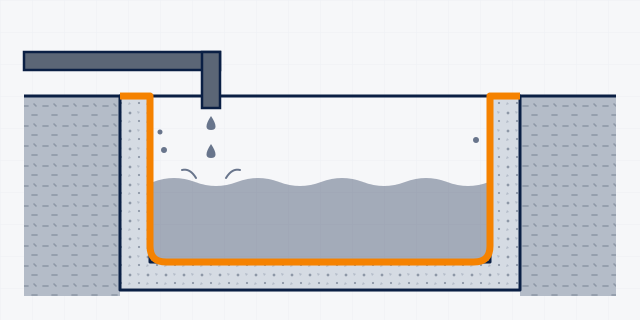
Concrete sump in the ground with a continuous protective lining inside, holding liquid fed by a dripping pipe.

Get this solution priced Proposal brief ↓

You need this when…

  • Soft, eroded concrete in sewage channels, manholes or wet wells
  • Exposed aggregate and rust in chemical or effluent tanks
  • Spills attacking floors and bund walls around chemical or fuel storage
  • Old coating blistering or peeling in a process tank
  • A new tank or bund that needs a chemical-resistant lining

The work, step by step

General guidance based on the manufacturer data sheets. Site conditions differ: confirm the system with MCT before you start. Where we do not name a product, ask us and we will confirm the right one.

  1. Step 1: Define the exposure

    List the chemicals, concentrations, temperatures and whether contact is splash or immersion; check each product's chemical-resistance data with us. Sikagard M 790 and Permacor-3326 EG H have test evidence for biogenic sulphuric acid in sewage (Sikagard M 790 p.2; Permacor-3326 EG H p.1).

  2. Step 2: Prepare a strong substrate

    Blast or mechanically prepare the concrete. Pull-off strength at least 1.5 N/mm² average, lowest 1.0 N/mm² (Sikagard P 770 p.3; Permacor-3326 EG H p.3). Sikagard PW also needs at least 25 N/mm² compressive strength (Sikagard PW p.3). Concrete at least 3–6 weeks old (Sikagard-63 N p.3).

  3. Step 3: Repair and level

    Rebuild eroded concrete with SikaEmaco S 488, listed for water treatment and sewerage facilities before coating (Emaco S 488 p.1). Level and fill pores with Sikagard-720 EpoCem, which also protects concrete in aggressive environments and acts as a temporary moisture barrier under resin coatings (Sikagard-720 EpoCem p.1).

    Sikagard-720 EpoCem Sika Professionals only

    Thin layer render Concrete pore filler/ levelling mortar Repairing minor defects (pores and honeycombed concrete) Protecting concrete in aggressive and chemical environments As a Temporary Moisture Barrier (TMB) for Sikafloor® or Sikagard resin products Sui… (TDS p.1)

    Temperature stated in TDS
    -30 °C min. / +80 °C max (TDS p.2)
    Pack
    Pre-batched 21 kg sets.
  4. Step 4: Damp substrates

    Sikagard-63 N must not go on moist substrates (p.3). On damp concrete use the moisture-tolerant Sikagard P 770 primer under Sikagard M 790 (Sikagard P 770 p.1), or SikaCor-950 F where application onto damp concrete is unavoidable, at most 6 % moisture (SikaCor-950 F p.1, p.3).

    SikaCor-950 F Sika Professionals only Request a quotation

    Protective coating for concrete and steel, for buried and submerged structures for hydraulic engineering constructions and as internal coating for tanks and reservoirs, e.g. (TDS p.1)

  5. Step 5: Apply the chemical-resistant lining

    Sikagard-63 N epoxy-novolac for chemical tanks, bunds and fuel and oil tanks, minimum 2 layers, 3 in harsh conditions (Sikagard-63 N p.1, p.2). Sikagard M 790 crack-bridging membrane for waste water, manholes, biogas and bunds (p.1). Sika Permacor-3326 EG H for sludge digesters and waste-water and chemical tanks (p.1). Sikagard PW where the lining must also suit potable water (p.1).

    Sikagard M 790 Sika Request a quotation

    Sikagard® M 790 is used in all protection applications where a high level of chemical resistance is required. This includes: Waste water treatment plants both in the inflow and outflow areas, Sewage effluent pipelines and manholes, Biogas plants, Secondary containment bunds in chemical and petroc… (TDS p.1)

    Temperature stated in TDS
    -20 °C to +80 °C (TDS p.3)
    Pack
    Sikagard® M 790 is available in | 5 kg Kits consisting of 1.5 kg Part A and 3.5 kg…
  6. Step 6: Seal bund and forecourt joints

    Sikaflex Tank N is designed for joints in storage tanks, containment bunds and petrol station floors handling water-polluting liquids; professional applicators only (Sikaflex Tank N p.1). Prime porous substrates as its TDS directs (p.4).

  7. Step 7: Cure and inspect

    Protect fresh Sikagard-63 N and Sikagard PW from rain, condensation and water for at least 24 hours (Sikagard-63 N p.3; Sikagard PW p.3). Apply on falling temperatures to avoid pinholes (Sikagard PW p.3). Permacor-3326 EG H allows the coating to be checked for pores (p.1).

Proposal brief

Chemical-resistant protection (tanks, bunds, sewage): scope and system

A starting point for a site proposal. Quantities, prices and the final specification follow a site visit or photos.

Scope of work

  1. Surface preparation by blasting of x m²
  2. Pull-off testing
  3. Concrete repair and levelling
  4. Primer and chemical-resistant lining, x coats over x m²
  5. Joint sealing in bunds and forecourts

System build-up

StepProductPackSource
3. Repair and levelSikaEmaco S 48825 kg bagTDS p.1 · June 2025, Version 05.01
3. Repair and levelSikagard-720 EpoCem (professionals)Pre-batched 21 kg sets.TDS p.1 · May 2021, Version 02.01
4. Damp substratesSikagard P 770—TDS p.1 · February 2025, Version 06.01
4. Damp substratesSikaCor-950 F (professionals)—TDS p.1 · December 2022, Version 03.01
5. Apply the chemical-resistant liningSikagard-63 N (professionals)10 kg Kit consisting ofTDS p.1 · May 2025, Version 04.02
5. Apply the chemical-resistant liningSikagard M 790Sikagard® M 790 is available in | 5 kg Kits consisting of 1.5 kg Part A and 3.5 kg…TDS p.1 · February 2025, Version 06.01
5. Apply the chemical-resistant liningSika Permacor-3326 EG H (professionals)—TDS p.1 · December 2022, Version 05.02
5. Apply the chemical-resistant liningSikagard PW (professionals)—TDS p.1 · May 2021, Version 02.01
6. Seal bund and forecourt jointsSikaflex Tank N (professionals)—TDS p.1 · September 2023, Version 01.02

What we need from you

  • List of chemicals, concentrations and temperatures
  • Splash, spillage or continuous immersion?
  • Tank or bund drawings and areas
  • Condition photos and age of the concrete
  • Shutdown period available and ventilation for confined spaces

Site conditions

  • Pull-off at least 1.5 N/mm² average (Sikagard P 770 p.3)
  • Concrete at least 3–6 weeks old (Sikagard-63 N p.3)
  • Dry or moisture-tolerant system chosen to suit substrate moisture (Sikagard-63 N p.3; Sikagard P 770 p.1)

Not included

  • Process shutdown, cleaning and gas-freeing of tanks
  • Structural repairs found after blasting, quoted after inspection
  • Chemical-resistance testing beyond published data

Questions customers ask

Which coating resists sewage gases and acids?

Sikagard M 790 (in the Sikagard-7000 CR system) and Sika Permacor-3326 EG H have test evidence for biogenic sulphuric acid (Sikagard M 790 p.2; Permacor-3326 EG H p.1).

Can the coating go on a damp wall?

Sikagard-63 N cannot (p.3). Sikagard P 770 primer is moisture tolerant (p.1), and SikaCor-950 F can be used where damp concrete is unavoidable (SikaCor-950 F p.1).

Can these line a drinking-water tank?

Of these, only Sikagard PW states suitability for direct contact with potable water (Sikagard PW p.1). SikaCor-950 F is not for drinking water (SikaCor-950 F p.1).

How strong must the concrete be?

Pull-off at least 1.5 N/mm² on average (Sikagard P 770 p.3; Permacor-3326 EG H p.3). Sikagard PW also needs at least 25 N/mm² compressive strength (Sikagard PW p.3).

What about joints in a fuel bund?

Sikaflex Tank N is designed for joints in storage tanks, bunds and petrol station floors handling water-polluting liquids, applied by professionals only (Sikaflex Tank N p.1).

Steps and product facts are taken from the manufacturer data sheets (page cited). Products are named only where the data sheet confirms the use; quantities follow a site visit or photos. General guidance: check the data sheet or ask us before you start.