

Skip to content
Step-by-step solution

Bonding new concrete or mortar to old

Joining fresh concrete, screeds, toppings, renders or repair mortar to existing hardened concrete, for slab thickening, extensions, toppings and repairs. The joint is only as good as the surface preparation and the bond coat.

  • 7 steps
  • 6 products
  • 5 answers
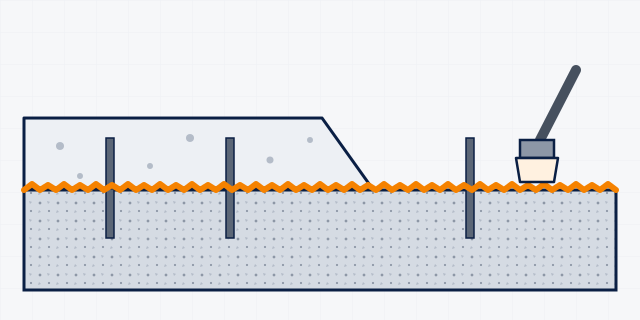
Old concrete slab with roughened top and dowels, a bonding coat brushed on, and new concrete placed over it.

Get this solution priced Proposal brief ↓

You need this when…

  • New topping or screed sounds hollow or lifts from the old slab
  • Cracks along the joint between old and new concrete
  • Planned slab thickening, staircase or extension against existing concrete
  • Old, smooth or worn concrete to receive a new render or topping
  • Repair patches that debond at the edges

The work, step by step

General guidance based on the manufacturer data sheets. Site conditions differ: confirm the system with MCT before you start. Where we do not name a product, ask us and we will confirm the right one.

  1. Step 1: Check whether the joint is structural

    If the new concrete must carry load together with the old (slab thickening, jackets, extensions), an engineer must design it, including any dowels; structural bonding needs an engineer's design calculations (Sikadur-32 LP p.3).

  2. Step 2: Prepare the old surface

    Remove laitance, oil, coatings and loose material and roughen until the aggregate shows, e.g. by shot blasting, sandblasting or high-pressure water jetting (Emaco S 488 p.2). For epoxy bonding the concrete must be at least 3–6 weeks old and dry or matt damp, with no standing water (Sikadur-32 LP p.3).

  3. Step 3: Structural epoxy bond for fresh concrete

    Sikadur-32 LP bonds fresh to hardened concrete (p.1). Brush it well in on matt damp concrete, then place the new concrete while the coat is still tacky; if it turns glossy, apply another coat (Sikadur-32 LP p.3, p.4). Application +20 °C to +40 °C (p.1). For experienced professionals only (p.1).

  4. Step 4: Epoxy bond for renders, toppings and screeds

    Sikadur ADH 1414 bonds renderings, granolithic toppings and concrete to concrete, and tolerates some moisture (Sikadur ADH 1414 p.1). Leave it to stand before overcoating, typically 60 minutes at 25 °C or 45 minutes at 40 °C (p.2).

  5. Step 5: Cementitious bonding slurry

    For screeds, renders and repair mortars, mix latex 1:1 with water, then with fresh cement and fine sand to a brushable slurry; brush it onto the pre-wetted surface and apply the mortar wet on wet (SikaLatex-200 SBR PK p.2; SikaLatex PK p.2). SikaBond DV PK is also used as bonding slurry for fresh to old concrete (SikaBond DV PK p.1).

    SikaLatex-200 SBR PK Sika Request a quotation

    SikaLatex®-200 SBR PK is used as bonding agent and site-mix mortar admixture for the following applications: Thin layer patching mortars, Renders, Floor screeds, Concrete repair mortars, Abrasion resistant linings, Tile fixing mortars. (TDS p.1,2)

  6. Step 6: Bond coat for repair mortars

    In concrete repairs, MonoTop-610 is the bonding primer: apply it to the pre-wetted concrete and place the repair mortar wet on wet (MonoTop-610 p.1, p.2).

  7. Step 7: Place and cure

    Cure the new screed, render or concrete with a fine water spray and polythene, or a curing membrane; poor curing can crack it (Sikadur ADH 1414 p.2). In heat, cure well to prevent plastic and drying shrinkage (SikaLatex-200 SBR PK p.2). Carry existing expansion joints through the new layer (Sikadur ADH 1414 p.2).

Proposal brief

Bonding new concrete or mortar to old: scope and system

A starting point for a site proposal. Quantities, prices and the final specification follow a site visit or photos.

Scope of work

  1. Surface preparation of x m² existing concrete
  2. Application of bond coat (epoxy or cementitious, per specification)
  3. Placing of new concrete, screed, topping or render by others or by us
  4. Curing of the new layer

System build-up

StepProductPackSource
3. Structural epoxy bond for fresh concreteSikadur-32 LP (professionals)—TDS p.1 · March 2025, Version 02.01
4. Epoxy bond for renders, toppings and screedsSikadur ADH 1414Sikadur® ADH 1414 is available in 2 litre kits containing the base resin andTDS p.1,2 · September 2024, Version 02.01
5. Cementitious bonding slurrySikaLatex-200 SBR PK—TDS p.1,2 · February 2026, Version 03.01
5. Cementitious bonding slurrySikaLatex PK05 ltr jerry can 20 ltr plastic can 200 ltr drum 1000 ltr IBC Bulk supply in tanker is…TDS p.1 · June 2025, Version 02.01
5. Cementitious bonding slurrySikaBond DV PK05 ltr jerry canTDS p.1 · June 2025, Version 02.01
6. Bond coat for repair mortarsSika MonoTop-610 (professionals)—TDS p.1 · May 2021, Version 01.01

What we need from you

  • What is being bonded: concrete pour, screed, topping, render or repair
  • Area (m²) and thickness of the new layer
  • Age and condition of the existing concrete
  • Is the joint structural? Engineer's drawings if yes
  • Expected pour dates and weather (summer or winter)

Site conditions

  • Existing concrete sound, roughened and at least 3–6 weeks old for epoxy bonding (Sikadur-32 LP p.3)
  • New concrete placed while the epoxy is tacky (Sikadur-32 LP p.4)
  • Temperature within the product range (Sikadur-32 LP p.1)

Not included

  • Structural design of dowels and connections
  • Supply and placing of new concrete unless listed in the scope

Questions customers ask

Do I need a bonding agent for every new pour?

Ask us: it depends on site conditions. For structural joints between fresh and hardened concrete, Sikadur-32 LP is the TDS-listed structural bonding agent (Sikadur-32 LP p.1).

How long do I have to pour after applying the epoxy?

Place concrete while Sikadur-32 LP is still tacky; if it turns glossy, apply another coat (p.4). The open time is about 120 to 270 minutes depending on temperature (Sikadur-32 LP p.3).

Can I brush plain SBR or latex onto the old surface?

No. Never use latex alone or a latex-water mix as a bonding bridge; always add cement and sand (SikaLatex PK p.2; SikaLatex-200 SBR PK p.2).

Can epoxy bonding be done in winter?

Sikadur-32 LP is applied at +20 °C to +40 °C (Sikadur-32 LP p.1). Sikadur ADH 1414 cures slowly in cold weather; 7–10 °C is the lowest for vertical rendering (Sikadur ADH 1414 p.2).

How old must the existing concrete be?

At least 3–6 weeks for Sikadur-32 LP (Sikadur-32 LP p.3).

Steps and product facts are taken from the manufacturer data sheets (page cited). Products are named only where the data sheet confirms the use; quantities follow a site visit or photos. General guidance: check the data sheet or ask us before you start.