

SikaRep® Fine PK can be used as a: Pore sealer / finishing mortar on cementitious substrates, Thin layer rendering on horizontal and vertical areas in building and civil engineering construction, for external and internal finishing etc, Levelling mortar on uneven substrates, and profiled concrete… (TDS p.1)
Step-by-step solution
Honeycombing, blowholes & voids
Honeycombing is concrete where the cement paste did not fill the gaps between the stones, leaving pores, pockets or hidden voids, often after poor compaction or leaking shuttering. Small surface defects are filled with fine mortars; deep pockets in load-bearing members need assessment and a structural repair.
- 7 steps
- 10 products
- 4 answers
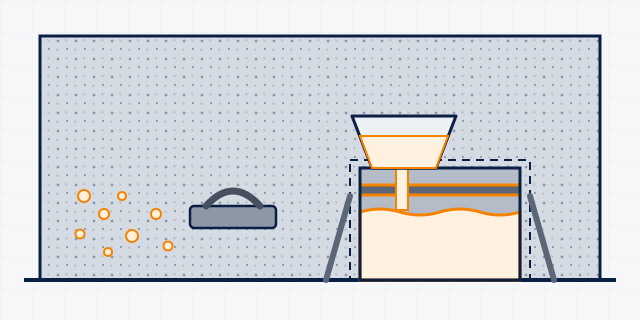
You need this when…
- Rough, stony patches on columns, beams or walls when the shuttering comes off
- Blowholes and small pores on fair-face concrete
- Gaps at column bases or at construction joints
- Steel visible inside a pocket
- Damp patches or seepage through porous areas
The work, step by step
General guidance based on the manufacturer data sheets. Site conditions differ: confirm the system with MCT before you start. Where we do not name a product, ask us and we will confirm the right one.
-
Step 1: Assess the depth
Tap and open up the area. Surface pores and blowholes are a finishing repair. Deep pockets, exposed steel or voids in columns, beams and slabs need an engineer's assessment; repairs follow EN 1504-10 (MonoTop-620 p.2).
-
Step 2: Cut back and prepare
Remove weak and deteriorated concrete to a sound base and clean any exposed steel (MonoTop-620 p.3). Pre-wet about 2 hours before, then remove excess water so the surface is dark matt with no water in the pores (MonoTop-620 p.3).
-
Step 3: Fill pores and shallow honeycombing
SikaRep Fine PK fills honeycombing and pores, 1–5 mm in one layer (SikaRep Fine PK p.1, p.2). MonoTop-620 repairs minor defects and needs no bonding primer on well-prepared concrete (MonoTop-620 p.1, p.3). SikaTop-121 fills blowholes and fine honeycombing, 2–5 mm (SikaTop-121 p.1, p.2). Sikagard-720 EpoCem fills pores 0.5–3 mm where chemical or moisture resistance is needed; professionals only (Sikagard-720 EpoCem p.1, p.3).
SikaRep Fine PK Sika Sika MonoTop-620 Sika Sika MonoTop®-620 can be applied with or withour a reinforcement matt, over concrete or mortar surfaces or over SikaTop® or Sika Monotop® mortars. It is suitable for the following uses: Use as a concrete/ mortar pore sealler or levelling mortar, Thin layer render over vertical or horizontal struc… (TDS p.1)
SikaTop-121 Sika Request a quotation Thin layer render Levelling of surfaces Protective coating for bridges parapets, retaining walls, etc. (TDS p.1)
Sikagard-720 EpoCem Sika Professionals only Thin layer render Concrete pore filler/ levelling mortar Repairing minor defects (pores and honeycombed concrete) Protecting concrete in aggressive and chemical environments As a Temporary Moisture Barrier (TMB) for Sikafloor® or Sikagard resin products Sui… (TDS p.1)
- Temperature stated in TDS
- -30 °C min. / +80 °C max (TDS p.2)
- Pack
- Pre-batched 21 kg sets.
-
Step 4: Repair deeper pockets
Where steel is exposed, coat it with MonoTop-610, two coats (MonoTop-610 p.3). Rebuild with SikaRep PK or MonoTop-612 PK, up to 30 mm per layer, in several layers for more depth (SikaRep PK p.2; MonoTop-612 PK p.2).
Sika MonoTop-610 Sika Professionals only Bonding primer as part of a concrete repair system Reinforcement corrosion protection as part of a concrete repair system (TDS p.1)
SikaRep PK Sika Repair of spalling and damaged concrete in buildings, bridges, infrastructure and superstructure works. (TDS p.1)
- Temperature stated in TDS
- +5 °C min / +35 °C max (TDS p.2)
- Pack
- 25 kg Bag
Sika MonoTop-612 PK Sika Sika MonoTop®-612 PK is used for structural concrete repairs as well as general patching to concrete and mortars. (TDS p.1)
-
Step 5: Recast large defects
Cut out to a regular shape, fix secure, watertight formwork and pour a flowable non-shrink material: SikaGrout-114 PK for cavities and gaps, 10–50 mm per pour (SikaGrout-114 PK p.2) or Sikacrete-114 PK micro-concrete at 50–500 mm per pour (Sikacrete-114 PK p.1, p.2).
Sikacrete-114 PK Sika Sikacrete®-114 PK is used for the structural repair of deteriorated concrete. (TDS p.1)
- Temperature stated in TDS
- +5 °C min. / +35 °C max (TDS p.2)
Other options for this stepAsk us The right product here depends on your site. We confirm it before naming it.
-
Step 6: Inject hidden voids
Voids that cannot be opened up can be filled by injection: Sikadur-52 LP epoxy fills and seals voids and cracks (Sikadur-52 LP p.1); Sika InjectoCem-190 microcement grout fills voids and protects embedded steel (InjectoCem-190 p.1). Injection is specialist work.
Sikadur-52 LP Sika Request a quotation Injection resin with good adhesion to concrete, mortar, stone, steel, and wood. (TDS p.1)
- Temperature stated in TDS
- +25 °C min. / +40 °C max (TDS p.2)
Sika InjectoCem-190 Sika Request a quotation Injection of Sika® Injectoflex® Systems Typ DI-1 and SikaFuko® injection hoses Filling of voids Final, rigid, cementitious sealing of cracks while simultaneously treating corroding or corrosion-prone reinforcing steel in concrete and mortar (TDS p.1)
-
Step 7: Cure and finish
Protect fresh mortar from drying with polythene or a moist membrane (MonoTop-620 p.3). In hot, dry weather fog lightly for 48 hours after final set (SikaRep Fine PK p.2). Coat if required, as in the protective-coatings guide.
Proposal brief
Honeycombing, blowholes & voids: scope and system
A starting point for a site proposal. Quantities, prices and the final specification follow a site visit or photos.
Scope of work
- Opening up and assessment of honeycombed areas
- Surface pore filling over x m²
- Break-out and mortar repair of x pockets
- Formwork and micro-concrete recasting where needed
- Injection of hidden voids if found
System build-up
| Step | Product | Pack | Source |
|---|---|---|---|
| 3. Fill pores and shallow honeycombing | SikaRep Fine PK | — | TDS p.1 · October 2023, Version 01.03 |
| 3. Fill pores and shallow honeycombing | Sika MonoTop-620 | — | TDS p.1 · May 2021, Version 01.01 |
| 3. Fill pores and shallow honeycombing | SikaTop-121 | — | TDS p.1 · May 2021, Version 01.01 |
| 3. Fill pores and shallow honeycombing | Sikagard-720 EpoCem (professionals) | Pre-batched 21 kg sets. | TDS p.1 · May 2021, Version 02.01 |
| 4. Repair deeper pockets | Sika MonoTop-610 (professionals) | — | TDS p.1 · May 2021, Version 01.01 |
| 4. Repair deeper pockets | SikaRep PK | 25 kg Bag | TDS p.1 · October 2023, Version 01.02 |
| 4. Repair deeper pockets | Sika MonoTop-612 PK | — | TDS p.1 · October 2023, Version 01.02 |
| 5. Recast large defects | Sikacrete-114 PK | — | TDS p.1 · March 2026, Version 02.02 |
| 6. Inject hidden voids | Sikadur-52 LP | — | TDS p.1 · March 2026, Version 02.01 |
| 6. Inject hidden voids | Sika InjectoCem-190 | — | TDS p.1 · May 2021, Version 03.01 |
What we need from you
- Photos of each defect with a scale
- Member type and whether it carries load
- Age of the concrete pour
- Is the finish fair-face (visible) or to be plastered?
- Any water seepage through the defect?
Site conditions
- Sound concrete around the repair
- +5 °C to +35 °C working temperature (SikaRep Fine PK p.2)
- Formwork, access and propping by the main contractor
Not included
- Engineer's assessment of deep defects in structural members
- Core testing or scanning to locate hidden voids
Questions customers ask
Which product fills honeycombing on a column face?
SikaRep Fine PK lists filling honeycombing and pores (SikaRep Fine PK p.1), and MonoTop-620 lists repairing pores and honeycombed concrete (MonoTop-620 p.1).
Do I need a bonding primer?
MonoTop-620 does not need one on a well-prepared, roughened substrate (MonoTop-620 p.1, p.3). For deeper repairs with exposed steel, MonoTop-610 is the bonding primer and rebar protection (MonoTop-610 p.1).
How thin can the filler go?
SikaRep Fine PK 1–5 mm in one layer (p.2); SikaTop-121 2–5 mm (p.2); Sikagard-720 EpoCem 0.5–3 mm, up to 5 mm on small spots (p.3).
What if the honeycomb goes deep into a column?
That needs an engineer's assessment. Sikacrete-114 PK is made for re-profiling damaged members with formwork, at 50–500 mm per pour (Sikacrete-114 PK p.1, p.2).
Steps and product facts are taken from the manufacturer data sheets (page cited). Products are named only where the data sheet confirms the use; quantities follow a site visit or photos. General guidance: check the data sheet or ask us before you start.