

Bonding primer as part of a concrete repair system Reinforcement corrosion protection as part of a concrete repair system (TDS p.1)
Step-by-step solution
Spalling concrete (chhajja, balcony, beam, column)
Concrete that cracks, bulges and falls away, usually with rusty steel behind it, on chhajjas, balcony slabs, beams, columns and tank slabs. This guide follows the EN 1504 sequence: remove, protect the steel, rebuild, seal and protect.
- 7 steps
- 10 products
- 5 answers
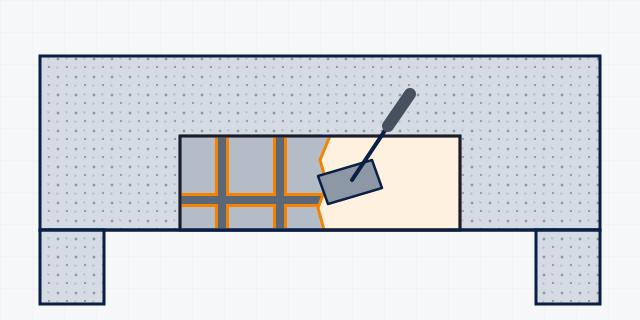
How the system works
The problem, and the system that solves it
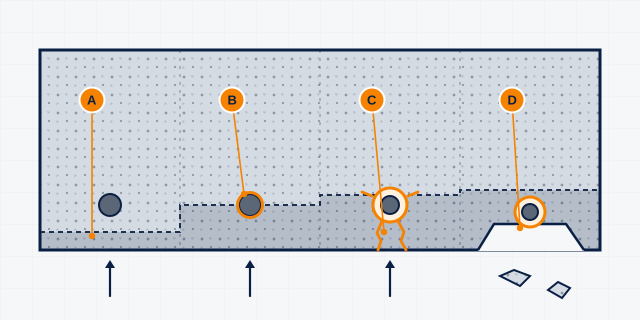
What goes wrong
- A: Carbon dioxide and chlorides from outside slowly penetrate the concrete cover.
- B: When they reach the steel, its protection is lost and it starts to rust.
- C: Rust takes up more space than steel; it pushes and cracks the cover along the bar.
- D: The cover breaks off (spalls), exposing the steel to faster corrosion.
How the system works
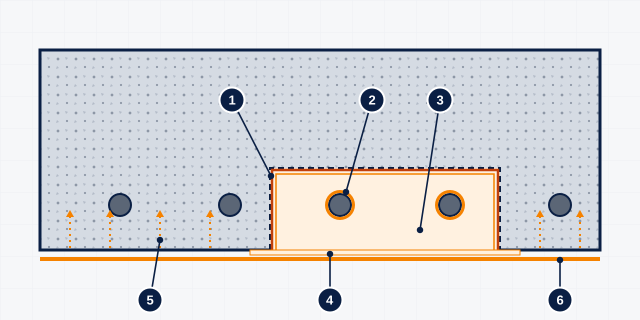
The repair removes the damaged concrete, protects the steel, rebuilds the section with a repair mortar and then protects the surrounding concrete. A surface-applied inhibitor helps steel that is at risk but not yet exposed. A protective coating slows carbon dioxide and chlorides from coming back in. Load-bearing members need an engineer's assessment first.
The system, layer by layer
-
Layer 1: Break out to sound concrete, clean the steel
What it does: Square-cut edges; damaged concrete removed behind the bars; rust cleaned off.
Why it is needed here: Repairs on weak or contaminated concrete fail; the steel must be clean to protect it.
-
Layer 2: Steel protection and bonding primer
What it does: A cementitious coating on the bars and the repair surface.
Why it is needed here: It restores protection to the steel and bonds the new mortar to the old concrete.
- Sika MonoTop-610 Professionals only TDS: 'Bonding primer as part of a concrete repair system' and 'Reinforcement corrosion protection as part of a concrete repair system' (p.1); rebar coat 2 mm minimum (p.2).
-
Layer 3: Repair mortar rebuilds the section
What it does: A structural repair mortar placed in layers, or poured into formwork for deep repairs.
Why it is needed here: It restores the concrete cover and the member's shape. Choose by depth: layered mortars up to about 30 mm per layer, or a flowable mortar for 50 to 500 mm pours.
- Sika MonoTop-612 PK TDS: 'used for structural concrete repairs as well as general patching to concrete and mortars … especially suited for overhead and vertical applications' (p.1); layers up to 30 mm (p.1, p.2).
- SikaRep PK TDS: 'Repair of spalling and damaged concrete in buildings, bridges, infrastructure' and 'Increasing cover with additional mortar and replacing contaminated or carbonated concrete' (p.1); 5–30 mm per layer (p.2).
- SikaEmaco S 488 TDS: EN 1504-3 class R4 mortar 'used for the structural repair of concrete elements such as columns, piers and cross beams', marine structures, water treatment and sewerage facilities (p.1); 6–40 mm in one layer (p.2).
- Sikacrete-114 PK TDS: 'used for the structural repair of deteriorated concrete … re-profiling of damaged concrete members, using framework [formwork]' (p.1); 50–500 mm per pour (p.2).
-
Layer 4: Pore sealer and levelling
What it does: A thin finishing mortar that closes pores and levels the surface.
Why it is needed here: Gives a dense, even surface ready for the protective coating.
- SikaRep Fine PK TDS: 'Pore sealer / finishing mortar on cementitious substrates' and 'Repair mortar to fill honeycombing, pores' (p.1); 1–5 mm in one layer (p.2).
- Sika MonoTop-620 TDS: EN 1504-3 R3 'pore sealer or levelling mortar', 'Repairing of minor defects (pores and honeycombed concrete)', 'Restoration of edges and joints' (p.1); 1.5–5 mm (p.2).
-
Layer 5: Corrosion inhibitor on the surrounding concrete
What it does: A liquid applied to the surface that migrates to the steel.
Why it is needed here: It protects reinforcement that is at risk but not yet exposed, around the repair.
- Sika FerroGard-903 Plus TDS: surface-applied corrosion inhibitor 'for undamaged reinforced concrete where reinforcing steel is corroding, or is at risk' that 'can be applied to the surface of existing repairs and to surrounding areas' (p.1).
-
Layer 6: Protective coating
What it does: An anti-carbonation coating over the whole surface.
Why it is needed here: It slows carbon dioxide and chlorides from re-entering, so the cycle does not start again. Use the crack-bridging version where cracks may open.
- Sikagard-680 S Betoncolor TDS: protective coating 'reducing the deterioration of concrete and assisting with controlling the corrosion of any embedded steel reinforcement', high CO2 diffusion resistance, 'Exterior use only' (p.1); 2 coats (p.3).
- Sikagard-550 W Elastic (G) TDS: crack-bridging anti-carbonation coating 'especially exposed outdoor concrete surfaces with a risk of cracking', used 'as an elastic protective coating on Sika smoothing mortars (SikaRep, Sika MonoTop range)' and on bricks, masonry and blocks (p.1).
Common mistakes to avoid
- Applying FerroGard-903 Plus to concrete in contact with drinking water, in tidal zones or on water-saturated concrete (Sika FerroGard-903 Plus p.3).
- Using Sikagard-680 S Betoncolor indoors: exterior use only (p.1).
- Building up more than 30 mm per layer with MonoTop-612 PK or SikaRep PK (p.2 each).
- Working below +5 °C or above +30–35 °C, in direct sun, strong wind or rain (Sika MonoTop-610 p.2; SikaRep PK p.2).
Products are named only where the data sheet confirms the use (verified); other layers say "Ask us". Diagrams are schematic, not to scale. Draft pending technical sign-off.
You need this when…
- Pieces of concrete falling from chhajja edges, balconies or slab soffits
- Cracks and rust stains running along the line of the steel bars
- Exposed, rusted reinforcement bars
- Hollow sound when the concrete is tapped
- Bulging or loose plaster on beams and columns
The work, step by step
General guidance based on the manufacturer data sheets. Site conditions differ: confirm the system with MCT before you start. Where we do not name a product, ask us and we will confirm the right one.
-
Step 1: Make safe and assess
Prop the area and keep people away if pieces may fall. Repairs to load-bearing beams, columns and slabs need an engineer's assessment first; repair work follows EN 1504-10 (MonoTop-620 p.2). The engineer decides whether badly corroded bars need extra steel.
-
Step 2: Break out to sound concrete and clean the steel
Remove delaminated, weak and damaged concrete, and enough concrete around corroded bars to clean them and compact mortar behind them. Clean rust, scale and loose material from the steel by abrasive blast cleaning (MonoTop-610 p.3), to Sa 2 (MonoTop-620 p.3).
-
Step 3: Protect the steel and prime the concrete
Brush a first coat of about 1 mm all round the bars; apply the second coat when the first is fingernail-hard, 2 mm minimum in total (MonoTop-610 p.2, p.3). Brush a thin bonding-primer coat onto the pre-wetted concrete and place the repair mortar wet on wet (MonoTop-610 p.2). For experienced professionals only (MonoTop-610 p.1).
Sika MonoTop-610 Sika Professionals only -
Step 4: Rebuild the concrete section
Pre-wet the substrate to saturated-surface-dry (MonoTop-612 PK p.2). MonoTop-612 PK suits overhead and vertical repairs, up to 30 mm per layer (MonoTop-612 PK p.1, p.2). SikaRep PK goes on 5–30 mm per layer, in several layers for deeper repairs (SikaRep PK p.2). For structural R4 repairs use SikaEmaco S 488, 6–40 mm in one layer (Emaco S 488 p.1, p.2). For deep sections cast in formwork use Sikacrete-114 PK, 50–500 mm per pour (Sikacrete-114 PK p.1, p.2).
Sika MonoTop-612 PK Sika Sika MonoTop®-612 PK is used for structural concrete repairs as well as general patching to concrete and mortars. (TDS p.1)
SikaRep PK Sika Repair of spalling and damaged concrete in buildings, bridges, infrastructure and superstructure works. (TDS p.1)
- Temperature stated in TDS
- +5 °C min / +35 °C max (TDS p.2)
- Pack
- 25 kg Bag
SikaEmaco S 488 Sika SikaEmaco® S 488 is used for the structural repair of concrete elements such as: Columns, piers and cross beams of bridges, Cooling towers and chimneys and other industrial environments, Water treatment and sewerage facilities before subsequent coating, Tunnels, pipes, outfalls and all below grou… (TDS p.1)
- Pack
- 25 kg bag
Sikacrete-114 PK Sika Sikacrete®-114 PK is used for the structural repair of deteriorated concrete. (TDS p.1)
- Temperature stated in TDS
- +5 °C min. / +35 °C max (TDS p.2)
-
Step 5: Cure the repair
Cover the finished mortar with clean wet hessian under polythene and keep it moist for 1–7 days depending on the weather (Emaco S 488 p.3). Do not work in direct sun or strong wind (MonoTop-620 p.2).
-
Step 6: Seal pores and level the surface
Close pores and level with a fine mortar: SikaRep Fine PK, 1–5 mm in one layer (SikaRep Fine PK p.2), or MonoTop-620, an R3 pore sealer and levelling mortar (MonoTop-620 p.1).
SikaRep Fine PK Sika SikaRep® Fine PK can be used as a: Pore sealer / finishing mortar on cementitious substrates, Thin layer rendering on horizontal and vertical areas in building and civil engineering construction, for external and internal finishing etc, Levelling mortar on uneven substrates, and profiled concrete… (TDS p.1)
Sika MonoTop-620 Sika Sika MonoTop®-620 can be applied with or withour a reinforcement matt, over concrete or mortar surfaces or over SikaTop® or Sika Monotop® mortars. It is suitable for the following uses: Use as a concrete/ mortar pore sealler or levelling mortar, Thin layer render over vertical or horizontal struc… (TDS p.1)
-
Step 7: Protect the surrounding concrete
Saturate the sound concrete around the repairs with FerroGard-903 Plus; it penetrates to the steel and slows corrosion (FerroGard-903 Plus p.1, p.4). Then coat with Sikagard-680 S Betoncolor, 2 coats, exterior use (Sikagard-680 S p.1, p.3), or the crack-bridging Sikagard-550 W Elastic (G) (p.1).
Sika FerroGard-903 Plus Sika For the corrosion protection of steel reinforced concrete structures above and below the ground. (TDS p.1)
- Temperature stated in TDS
- +5 °C min. / +40 °C max (TDS p.2)
- Pack
- 25 kg pail
Sikagard-680 S Betoncolor Sika As a protective and decorative coating for: The protection and enhancement of concrete cementitious substrates on building and infrastructure elements, Reducing the deterioration of concrete and assisting with controlling the corrosion of any embedded steel reinforcement, Increasing the service l… (TDS p.1)
- Temperature stated in TDS
- +5 °C min. / +35 °C max (TDS p.3)
Sikagard-550 W Elastic (G) Sika Request a quotation Sikagard®-550 W Elastic (G) is used for protection and enhancement of concrete structures (normal and lightweight concrete), especially exposed outdoor concrete surfaces with a risk of cracking. (TDS p.1)
- Temperature stated in TDS
- +8°C min. / +40°C max (TDS p.3)
Proposal brief
Spalling concrete (chhajja, balcony, beam, column): scope and system
A starting point for a site proposal. Quantities, prices and the final specification follow a site visit or photos.
Scope of work
- Break-out of delaminated concrete over x m² / x running metres
- Cleaning of reinforcement and two-coat rebar protection
- Re-profiling with polymer-modified repair mortar (average x mm thick)
- Pore sealing and levelling coat
- Corrosion inhibitor on surrounding sound concrete
- Two-coat protective coating
System build-up
| Step | Product | Pack | Source |
|---|---|---|---|
| 3. Protect the steel and prime the concrete | Sika MonoTop-610 (professionals) | — | TDS p.1 · May 2021, Version 01.01 |
| 4. Rebuild the concrete section | Sika MonoTop-612 PK | — | TDS p.1 · October 2023, Version 01.02 |
| 4. Rebuild the concrete section | SikaRep PK | 25 kg Bag | TDS p.1 · October 2023, Version 01.02 |
| 4. Rebuild the concrete section | SikaEmaco S 488 | 25 kg bag | TDS p.1 · June 2025, Version 05.01 |
| 4. Rebuild the concrete section | Sikacrete-114 PK | — | TDS p.1 · March 2026, Version 02.02 |
| 6. Seal pores and level the surface | SikaRep Fine PK | — | TDS p.1 · October 2023, Version 01.03 |
| 6. Seal pores and level the surface | Sika MonoTop-620 | — | TDS p.1 · May 2021, Version 01.01 |
| 7. Protect the surrounding concrete | Sika FerroGard-903 Plus | 25 kg pail | TDS p.1 · May 2025, Version 03.01 |
| 7. Protect the surrounding concrete | Sikagard-680 S Betoncolor | — | TDS p.1 · December 2022, Version 04.01 |
| 7. Protect the surrounding concrete | Sikagard-550 W Elastic (G) | — | TDS p.1 · May 2025, Version 04.01 |
What we need from you
- Photos of each damaged area with a tape for scale
- Member type: chhajja, balcony, beam, column, slab soffit, tank slab
- Approximate area and depth of damage
- Building age and distance from the sea or salty ground water
- Access: height, scaffolding, occupied or not
Site conditions
- Air and surface between +5 °C and +35 °C; summer work in the early morning with chilled water (MonoTop-612 PK p.2)
- No rain during application of the inhibitor (FerroGard-903 Plus p.3)
- Safe access and propping by the client or main contractor
Not included
- Structural design, propping design and replacement of reinforcement are quoted separately after an engineer's assessment
- Plaster and paint finishes beyond the repaired area
Questions customers ask
Can I just plaster over the broken area?
No. Repair materials go only on sound, prepared substrates (MonoTop-610 p.2), and loose concrete must be removed and the rusted steel cleaned first (MonoTop-610 p.3).
How thick can the repair be in one go?
MonoTop-612 PK up to 30 mm per layer, SikaRep PK 5–30 mm per layer and SikaEmaco S 488 6–40 mm in one layer. Deeper sections are built in layers or cast with Sikacrete-114 PK at 50–500 mm per pour (MonoTop-612 PK p.2; SikaRep PK p.2; Emaco S 488 p.2; Sikacrete-114 PK p.2).
Can the repair be done in June heat?
Repair mortars are limited to +35 °C. Above +35 °C, store MonoTop-612 PK in shade and mix with chilled water (MonoTop-612 PK p.2). MonoTop-610 is limited to +30 °C (MonoTop-610 p.2), so plan work for early morning.
When can I paint or coat the repair?
Sikagard-550 W Elastic (G) can go on cement-based repair mortars after at least 5 days (Sikagard-550 W Elastic (G) p.4).
Does the corrosion inhibitor replace the repair?
No. Visible defects such as spalling and cracks must be repaired by conventional methods; FerroGard-903 Plus treats the surrounding concrete (FerroGard-903 Plus p.3).
Steps and product facts are taken from the manufacturer data sheets (page cited). Products are named only where the data sheet confirms the use; quantities follow a site visit or photos. General guidance: check the data sheet or ask us before you start.