

Non-moving (static) cracks and holes with running water or moisture seepage For immersion service For anchoring vertical bolts Basements Foundations Retaining walls Sewers Locations Vertical, overhead, or horizontal Interior or exterior Above or below grade… (TDS p.1)
Step-by-step solution
Leaking cracks & active water seepage
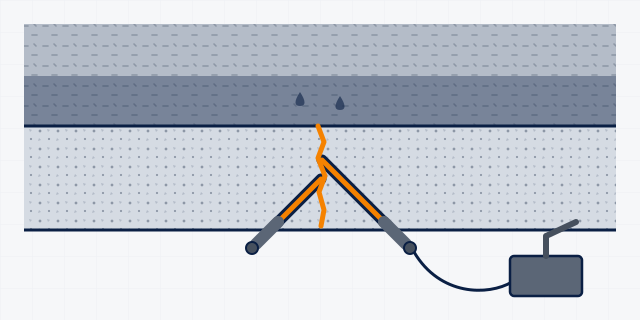
Cracks and holes that let water through basement walls, tanks, roof slabs or retaining walls. First stop running water, then seal the crack with elastic injection, then waterproof the surface; rigid epoxy is not used while a crack is wet.
- 7 steps
- 8 products
- 4 answers
You need this when…
- Water dripping or running through a crack in a basement wall or slab
- A wet line along a crack after rain or when the tank is full
- Seepage at construction joints and pipe entries
- White salt deposits along a crack
- Leaks that get worse in the monsoon or when ground water rises
The work, step by step
General guidance based on the manufacturer data sheets. Site conditions differ: confirm the system with MCT before you start. Where we do not name a product, ask us and we will confirm the right one.
-
Step 1: Find the source and check the structure
Note whether water runs or only seeps, and whether the crack is in a load-bearing member; structural cracks also need an engineer (see structural-cracks). Before curtain injection near buildings, survey the site and foundations and check there are no drains or open pipes near the injection areas (Injection-306 p.2).
-
Step 2: Stop running water
For holes and static cracks with running water, cut a square or undercut slot at least 19 mm wide and deep (no V-cut), mix SikaSet Waterplug for no more than 30 seconds, place within 3 minutes and hold it until set (Waterplug p.2, p.3). Or mix Sika-4a with cement into a plug by gloved hand; under heavy flow, divert water through plastic tubes first (Sika-4a p.2).
SikaSet Waterplug Sika Request a quotation Sika-4a Sika Sika®-4a is used as preliminary waterproofing work on wet surfaces or where there is general infiltration of water, prior to the application of subsequent cementitious render or gunite. (TDS p.1)
- Temperature stated in TDS
- +5 °C min. / +35 °C max (TDS p.2)
-
Step 3: Inject the crack
Sika Injection-306 is a very low-viscosity, elastic polyacrylic resin for water-bearing cracks, voids and joints, and tolerates minor movement (Injection-306 p.1). Its reaction time is adjustable from 10 to 60 minutes and must be checked on site before injecting (p.1, p.3). Experienced professionals only (p.1).
Sika Injection-306 Sika Professionals only Request a quotation Crack and joint injection Injection of SikaFuko® injection hoses to seal construction joints Sealing water-bearing cracks and voids Sealing all types of leaking building components in damp or water saturated ground conditions Sealing leaks where there is so… (TDS p.1)
- Temperature stated in TDS
- +5 °C min. / +40 °C max (TDS p.2)
-
Step 4: Structural epoxy only once dry
Sikadur-52 LP is not for wet injection (Sikadur-52 LP p.2). Once the crack is permanently dry and an engineer needs a structural bond, follow the Structural cracks guide.
-
Step 5: Waterproof the surface
Coat the treated area with a cementitious waterproofing that resists water pressure: Sika Thoroseal Plus resists positive and negative pressure; patch holes and cracks with Waterplug first (Thoroseal Plus p.1, p.2). Or SikaTop-107 Seal PK, two coats, no more than 2 kg/m² per coat (SikaTop-107 p.2).
Sika Thoroseal Plus Sika Request a quotation Diverse building substrates Walls Foundations Tunnels Basements Blocks, bricks, stone and concrete Concrete High tanks Interior and exterior (TDS p.1)
- Pack
- 35 lb (15.9 kg) pail
Other options for this stepAsk us The right product here depends on your site. We confirm it before naming it.
-
Step 6: Seal moving cracks and joints
Where a crack or joint keeps moving, bridge it with Sikadur-Combiflex SG-20 P tape, made for joints and cracks in basements and water-retaining structures, bonded with Sikadur-31 DW (Combiflex SG-20 P p.1, p.3). Professionals only (Sikadur-31 DW p.1).
Sikadur-Combiflex SG-20 P Sika Request a quotation Sikadur-Combiflex® SG-20 P is used for sealing: Movement joints, Construction joints, Pipe penetrations, Cracks, Building components where differential settlement is expected Sikadur-Combiflex® SG-20 P is used for the following areas:, Tunnels. (TDS p.1)
- Temperature stated in TDS
- +40 °C -30 °C (TDS p.2)
Sikadur-31 DW Sika Professionals only Request a quotation Structural adhesive for bonding: Concrete elements, Hard natural stone, Ceramics, fibre cement, Mortar, Bricks, Masonry, Steel, Iron, Aluminium, Wood. (TDS p.1)
- Temperature stated in TDS
- +10 °C to +30 °C (TDS p.1)
-
Step 7: Drinking-water tanks
If the leak is in a drinking-water tank, finish with a lining whose TDS states potable suitability: SikaTop-550 Seal or Sikagard PW (06 F2); Sikagard PW is for experienced professionals only (Sikagard PW p.1). Follow local cleaning and disinfection rules (Sikagard PW p.3). See the water-tank guides.
SikaTop-550 Seal Sika As a waterproof lining for water retaining structures. (TDS p.1)
- Temperature stated in TDS
- +5°C min. / 40°C max (TDS p.2)
Sikagard PW Sika Professionals only Chemical resistant protective layer on concrete, structural cementitious mortars, epoxy cement, epoxy resin based products and steel Protection of concrete surfaces / foundations below ground level Lining in storage tanks, manholes, intakes and silos etc. (TDS p.1)
- Temperature stated in TDS
- +5 °C min. / +40 °C max (TDS p.2)
Proposal brief
Leaking cracks & active water seepage: scope and system
A starting point for a site proposal. Quantities, prices and the final specification follow a site visit or photos.
Scope of work
- Leak survey and marking of x cracks / x running metres
- Plugging of active leaks
- Resin injection of x m of cracks
- Cementitious waterproof coating of x m²
- Crack or joint tape where movement continues
System build-up
| Step | Product | Pack | Source |
|---|---|---|---|
| 2. Stop running water | SikaSet Waterplug | — | TDS p.1 · September 2024, Version 02.01 |
| 2. Stop running water | Sika-4a | — | TDS p.1 · May 2021, Version 01.01 |
| 3. Inject the crack | Sika Injection-306 (professionals) | — | TDS p.1 · May 2021, Version 02.01 |
| 5. Waterproof the surface | Sika Thoroseal Plus | 35 lb (15.9 kg) pail | TDS p.1 · September 2024, Version 02.01 |
| 6. Seal moving cracks and joints | Sikadur-Combiflex SG-20 P | — | TDS p.1 · May 2025, Version 04.01 |
| 6. Seal moving cracks and joints | Sikadur-31 DW (professionals) | — | TDS p.1 · May 2021, Version 03.01 |
| 7. Drinking-water tanks | SikaTop-550 Seal | — | TDS p.1 · March 2024, Version 01.01 |
| 7. Drinking-water tanks | Sikagard PW (professionals) | — | TDS p.1 · May 2021, Version 02.01 |
What we need from you
- Photos or a short video of the leak
- Location: basement, tank (drinking water or not), roof slab, retaining wall
- Is water running, dripping or only damp?
- Does it change with rain, season or tank level?
- Access to both sides of the wall or slab?
Site conditions
- Site and foundations surveyed before injection; no drains or open pipes near injection areas (Injection-306 p.2)
- Tank emptied or water level lowered where possible
- Injection-306 applied between +5 °C and +40 °C (Injection-306 p.2)
Not included
- Structural repairs or strengthening found during the survey
- Dewatering, excavation and external membrane works
- Disinfection of drinking-water tanks before reuse
Questions customers ask
Can epoxy be used on a leaking crack?
Not while it is wet. Sikadur-52 LP is for dry and damp cracks only (Sikadur-52 LP p.2). Water-bearing cracks are sealed with Sika Injection-306 (Injection-306 p.1).
Will the seal move with the crack?
Injection-306 stays elastic and can absorb limited movement (Injection-306 p.1). SikaSet Waterplug is rigid and is not for moving cracks (Waterplug p.2).
How quickly does the plug work?
SikaSet Waterplug is placed within 3 minutes of mixing and can be top-coated after 15 minutes (Waterplug p.1, p.2).
Can it be fixed from inside the basement?
Often yes: Sika Thoroseal Plus resists positive and negative water pressure (Thoroseal Plus p.1), and under negative pressure two coats may be needed (p.2). For strong pressure, ask us: it depends on site conditions.
Steps and product facts are taken from the manufacturer data sheets (page cited). Products are named only where the data sheet confirms the use; quantities follow a site visit or photos. General guidance: check the data sheet or ask us before you start.