

Non-moving (static) cracks and holes with running water or moisture seepage For immersion service For anchoring vertical bolts Basements Foundations Retaining walls Sewers Locations Vertical, overhead, or horizontal Interior or exterior Above or below grade… (TDS p.1)
Step-by-step solution
Leaking or damaged swimming pool
Older pools lose water through cracks, joints, pipe entries and failed grout, and tiles start to drum or fall off. Find the leak, repair the shell, renew the waterproofing and re-tile with pool-rated products.
- 6 steps
- 5 products
- 4 answers
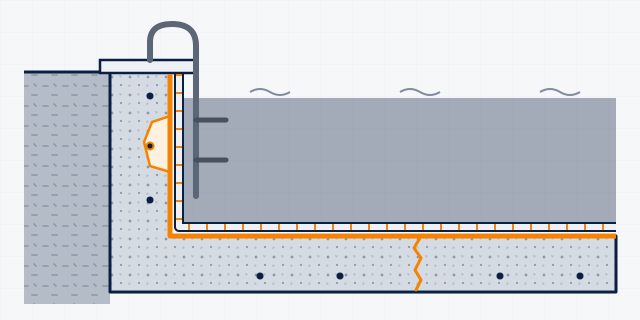
You need this when…
- Water level drops faster than normal evaporation
- Hollow-sounding, loose or missing tiles
- Cracked, washed-out or black grout
- Seepage in the plant room or a neighbouring basement
- Rust stains or spalling concrete on the shell
The work, step by step
General guidance based on the manufacturer data sheets. Site conditions differ: confirm the system with MCT before you start. Where we do not name a product, ask us and we will confirm the right one.
-
Step 1: Find the leak and drain
Have the pool plumber test pipes and fittings first. Drain the pool, tap every tile and map loose tiles, cracks, joints and pipe entries. Wide, moving or structural cracks need an engineer's assessment before repair.
-
Step 2: Strip loose tiles and weak material
Remove debonded tiles, old adhesive and grout, and any loose or contaminated concrete, back to a sound, clean surface free of oil, grease, dust and laitance (SikaTop-107 Seal PK p.3).
-
Step 3: Stop leaks and seal cracks
Running holes: SikaSet Waterplug (p.1). Water-bearing cracks and leaks with minor movement: Sika Injection-306, experienced professionals only (p.1). Dry or damp non-structural cracks up to 10 mm: Sikadur-20 Crack Seal (swimming pools, p.1; limits p.2).
SikaSet Waterplug Sika Request a quotation Sikadur-20 Crack Seal Sika Request a quotation To fill and seal non-structural crack and cavities in structural concrete such as concrete decks, balconies, concrete roof structures, wet room, swimming pool and especially before waterproofing works. (TDS p.1)
- Pack
- 160 mL and 850 mL set
Other options for this stepAsk us The right product here depends on your site. We confirm it before naming it.
-
Step 4: Repair the concrete
Clean rusted steel and coat it with Sika MonoTop-610, a bonding primer and corrosion protection for experienced professionals (p.1). Rebuild with Sika MonoTop-612 PK or SikaRep PK (spalling and damaged concrete, p.1). Above 35 °C, use chilled mixing water (MonoTop-612 PK p.2).
Product for this stepAsk us The right product here depends on your site. We confirm it before naming it.
-
Step 5: Renew the waterproofing
Pre-wet the shell and apply SikaTop-107 Seal PK in at least 2 coats (p.3), max 2 kg/m² per coat (p.2), second coat within 48 hours (p.3). Damp-cure and protect from sun and wind (p.3).
SikaTop-107 Seal PK Sika For external and internal waterproofing, on concrete, mortar, brickwork, and steel in: Basements, Swimming pools, Water tanks, Flat roofs, Balconies, terraces, Bridges. (TDS p.1)
- Temperature stated in TDS
- +5 °C min. / +35 °C max (TDS p.2)
-
Step 6: Re-tile and regrout
Fix tiles with SikaCeram-205 PK (swimming pools, p.1); ask us to confirm it over SikaTop-107 (06 S3). Grout indoor pools with SikaCeram-850 Design (p.1) and thermal, mineral or salt-water pools with Sikadur-54 Ceramic (professionals only, p.1). Joint sealants: see the New swimming pool guide.
SikaCeram-850 Design Sika Grouting tiles for the following interior residential and commercial building applications: Wet rooms, Shopping malls, Hospitals, Commercial / Industrial kitchens, Food industry, Swimming pools (indoors). (TDS p.1)
- Temperature stated in TDS
- +5 °C min. / +35 °C max (TDS p.2)
- Pack
- 400 ml double side-by-side cartridge
Sikadur-54 Ceramic Sika Professionals only Sikadur®-54 Ceramic s used for rigid, waterproof and chemical resistant sealing of joints in ceramic wall and floor coverings, which are subjected to chemical and mechanical attack. Chemical/acids: Laboratories, Food and beverage industries, Medical and therapeutic rooms. Aggressive water:, Swimm… (TDS p.1)
Other options for this stepAsk us The right product here depends on your site. We confirm it before naming it.
Proposal brief
Leaking or damaged swimming pool: scope and system
A starting point for a site proposal. Quantities, prices and the final specification follow a site visit or photos.
Scope of work
- Leak survey with the pool plumber, draining and tile sounding
- Removal of loose tiles, adhesive and weak concrete (m²)
- Leak plugging, crack injection and crack sealing (running metres)
- Concrete and rebar repair
- 2-coat waterproofing, re-tiling and pool-rated grouting (m²)
System build-up
| Step | Product | Pack | Source |
|---|---|---|---|
| 3. Stop leaks and seal cracks | SikaSet Waterplug | — | TDS p.1 · September 2024, Version 02.01 |
| 3. Stop leaks and seal cracks | Sikadur-20 Crack Seal | 160 mL and 850 mL set | TDS p.1 · March 2025, Version 03.02 |
| 5. Renew the waterproofing | SikaTop-107 Seal PK | — | TDS p.1 · May 2026, Version 03.02 |
| 6. Re-tile and regrout | SikaCeram-850 Design | 400 ml double side-by-side cartridge | TDS p.1 · April 2025, Version 01.01 |
| 6. Re-tile and regrout | Sikadur-54 Ceramic (professionals) | — | TDS p.1 · May 2021, Version 01.01 |
What we need from you
- Pool size, depths and age
- How much water is lost per day
- Photos of cracks, loose tiles and the plant room
- Indoor or outdoor; fresh, salt, thermal or mineral water
- Spare tiles available, or new tiles needed?
Site conditions
- Pool drained and dry for the work
- Application between +5 °C and +35 °C (SikaTop-107 Seal PK p.2)
- Plumbing leaks repaired by others before waterproofing
Not included
- Structural repairs, quoted after an engineer's assessment
- Pool plumbing, pumps, filters and lights
- Supply of tiles
Questions customers ask
Can you repair only the leaking spot?
If the leak is local and the rest is sound, water-bearing cracks can be injected (Sika Injection-306 p.1) and non-structural cracks sealed (Sikadur-20 Crack Seal p.1). If many tiles are hollow, the waterproofing usually has to be renewed. Ask us: it depends on site conditions.
Why did our pool tiles fall off?
One common cause is an adhesive that is not made for immersion. For example, SikaCeram-51 must not be used in water-immersed areas such as swimming pools (p.2). SikaCeram-205 PK is listed for swimming pools (p.1).
Can we tile over the old tiles?
SikaCeram-205 PK lists indoor over-tiling on old tiles (p.1), but a leaking pool needs new waterproofing underneath, so we normally strip to the shell. Ask us: it depends on site conditions.
How long before we can refill?
The data sheets give curing steps (SikaTop-107 Seal PK p.3) but no refill time. Ask us: it depends on site conditions.
Steps and product facts are taken from the manufacturer data sheets (page cited). Products are named only where the data sheet confirms the use; quantities follow a site visit or photos. General guidance: check the data sheet or ask us before you start.