

The right product here depends on your site. We confirm it before naming it.
Step-by-step solution
Bathroom waterproofing (under tiles)
Most home leaks start in bathrooms: water gets through grout and cracks, runs along the slab and shows as seelan on the ceiling below or the wall next door. Strip, seal cracks, waterproof the floor and lower walls, then tile, grout and seal the fittings.
- 6 steps
- 8 products
- 4 answers
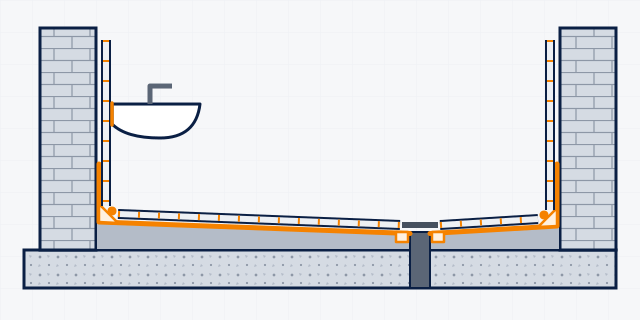
How the system works
The problem, and the system that solves it
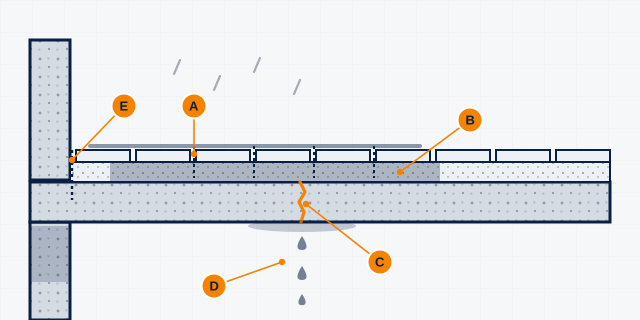
What goes wrong
- A: Grout and tiles are not waterproof; water soaks through open or cracked grout.
- B: The screed under the tiles fills with water like a sponge.
- C: Cracks in the slab carry the water through.
- D: It appears as stains and drips on the ceiling below.
- E: The wall-to-floor joint and wall base let water run into the walls.
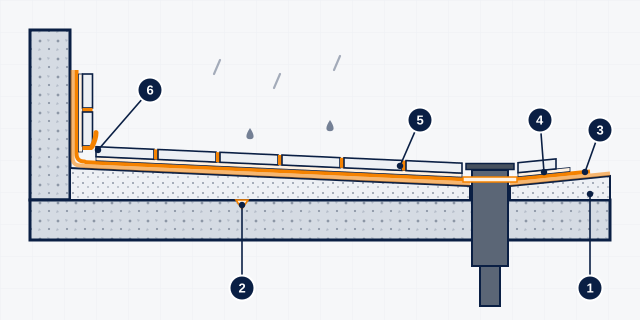
How the system works
The tiles are only the finish. The waterproofing is a membrane under them that forms a tray: across the floor, turned up the walls and sealed into the drain. The screed falls to the drain so water never stands, and the last layer of defence is a flexible sealant at corners and fittings.
The system, layer by layer
-
Layer 1: Screed laid to falls
What it does: A screed sloping to the floor drain.
Why it is needed here: Water must run to the drain, not stand on the floor.
Waterproof screed admixture: Ask us for the right product
-
Layer 2: Cracks sealed
What it does: Fills and seals non-structural cracks in the concrete before waterproofing.
Why it is needed here: Open cracks would break the membrane's continuity.
- Sikadur-20 Crack Seal TDS: seal non-structural cracks in concrete 'such as ... wet room' and 'Repair floor tile joint for leakage treatment' (p.1); max 10 mm, 28-day concrete (p.2).
-
Layer 3: Waterproofing under the tiles: floor, coved corner, walls and drain
What it does: A flexible cementitious membrane in at least two layers, turned up the walls and sealed into the drain flange.
Why it is needed here: This is the actual waterproof layer. Turning it up the walls makes a closed tray, and bonding it into the drain stops water tracking along the pipe.
- SikaTop-550 Seal TDS: 'For waterproofing of wet areas under tiling' (p.1); min 2 layers of 1 mm (p.2).
- SikaSeal-105 PK TDS: suitable for 'Balconies, bathrooms etc.' (p.1).
-
Layer 4: Tile adhesive
What it does: A flexible cement-based adhesive bonding the tiles to the membrane.
Why it is needed here: It must bond to the membrane and tolerate wet service. Check compatibility with the membrane supplier.
Flexible tile adhesive (C2TE class): Ask us for the right product
-
Layer 5: Tiles and wet-area grout
What it does: The finish and the grout that fills the joints.
Why it is needed here: Grout for wet rooms resists water and staining; epoxy grouts suit interiors, cement grout for wet areas must be mixed with a latex.
- SikaCeram-850 Design TDS: grouting tiles for interior applications incl. 'Wet rooms' (p.1).
- SikaCeram-855 TDS: 'suitable for wet rooms areas such as kitchens and bathrooms'; 'not suitable for external applications' (p.1).
- SikaCeram-600 Tile Grout PK TDS: grout for 'Floor and wall', 'Interior and exterior', 'Dry and wet area' (p.1); for wet area mix with Sika Latex (p.2).
-
Layer 6: Flexible sealant at corners and fittings
What it does: An anti-fungal silicone bead where tiles meet walls, baths, basins and trays.
Why it is needed here: These joints move; rigid grout cracks there and lets water in.
- Sikasil-715 WS TDS: 'can be used for wet area joints in bathroom, toilet and kitchen and around the sanitaryware'; antifungal ASTM G21 (p.1).
- Sika Sanisil TDS: 'Sanitary or other sealing applications where mildew and fungus resistance is required' (p.1).
Common mistakes to avoid
- Tiling vertical surfaces over SikaTop-550 Seal without first consulting Sika (SikaTop-550 Seal p.2).
- Using SikaCeram-850 Design or SikaCeram-855 outdoors: interior only (p.1 each); SikaCeram-600 in wet areas mixed with water only (p.2 requires Sika Latex).
- Silicone under permanent water immersion or pressure (Sikasil-715 WS p.3); Sanisil on porous stone or concrete (Sika Sanisil p.2).
- Sealing cracks over 10 mm or in concrete younger than 28 days (Sikadur-20 Crack Seal p.1–2).
Products are named only where the data sheet confirms the use (verified); other layers say "Ask us". Diagrams are schematic, not to scale. Draft pending technical sign-off.
You need this when…
- Damp patch or peeling paint on the ceiling below the bathroom
- Seelan on the wall behind or next to the bathroom
- Dark, crumbling or missing grout and a musty smell
- Hollow or loose floor tiles
- Water standing on the floor instead of running to the drain
The work, step by step
General guidance based on the manufacturer data sheets. Site conditions differ: confirm the system with MCT before you start. Where we do not name a product, ask us and we will confirm the right one.
-
Step 1: Strip, check plumbing and re-screed
Remove old tiles and screed down to the slab where it leaks. Have the plumber pressure-test supply pipes and check drain joints before any waterproofing. Re-lay the screed with a fall to the drain; Sika-1 PK can waterproof screeds and renders (p.1).
Product for this stepAsk us -
Step 2: Seal cracks
Fill non-structural cracks up to 10 mm with Sikadur-20 Crack Seal, which lists wet rooms (p.1). The surface may be damp but free of standing water, and the concrete at least 28 days old (p.2).
Sikadur-20 Crack Seal Sika Request a quotation To fill and seal non-structural crack and cavities in structural concrete such as concrete decks, balconies, concrete roof structures, wet room, swimming pool and especially before waterproofing works. (TDS p.1)
- Pack
- 160 mL and 850 mL set
-
Step 3: Waterproof under the tiles
SikaTop-550 Seal is listed for waterproofing wet areas under tiling (p.1); apply at least 2 layers (p.2). SikaSeal-105 PK lists bathrooms (p.1). Cover the whole floor and turn the coating up the walls, full height in the shower zone, with an extra coat at corners, pipe entries and the drain. For tiling on vertical surfaces over SikaTop-550, ask us first (p.2).
SikaTop-550 Seal Sika As a waterproof lining for water retaining structures. (TDS p.1)
- Temperature stated in TDS
- +5°C min. / 40°C max (TDS p.2)
SikaSeal-105 PK Sika SikaSeal®-105 PK is used as an economical and easy to use as waterproofing slurry both for external and internal applications. SikaSeal®-105 PK is suitable for the following applications: Water and sewage works, such as tanks and manholes, Basements and lift pits, Retaining walls and bridge struc… (TDS p.1)
- Temperature stated in TDS
- +5 °C min. / +40 °C max (TDS p.2)
-
Step 4: Fix the tiles
SikaCeram-205 PK is a flexible adhesive; cementitious substrates must be at least 28 days old (p.1, p.2). SikaCeram-90 PK must not go directly on gypsum (p.2). SikaCeram-51 is not for wet areas (p.2). See the Wall tiles and Floor tiles guides.
Product for this stepAsk us The right product here depends on your site. We confirm it before naming it.
-
Step 5: Grout the tiles
Epoxy grouts: SikaCeram-850 Design lists wet rooms (p.1); SikaCeram-855 is for indoor wet areas such as bathrooms (p.1). Cement grout: SikaCeram-600 Tile Grout PK, mixed with Sika Latex instead of water for wet areas (p.2).
SikaCeram-850 Design Sika Grouting tiles for the following interior residential and commercial building applications: Wet rooms, Shopping malls, Hospitals, Commercial / Industrial kitchens, Food industry, Swimming pools (indoors). (TDS p.1)
- Temperature stated in TDS
- +5 °C min. / +35 °C max (TDS p.2)
- Pack
- 400 ml double side-by-side cartridge
SikaCeram-855 Sika Request a quotation Suitable for grouting applications on most types of ceramic, porcelain and non-absorbent tiles for indoor wet areas. (TDS p.1)
- Temperature stated in TDS
- +5 °C min. / +35 °C max (TDS p.2)
- Pack
- 350ML
SikaCeram-600 Tile Grout PK Sika Request a quotation For filling the spaces of homogeneous tile, ceramic tile, marble, granite, mosaic, and natural stone, over a range of applications as below: Floor and wall, Interior and exterior, Dry and wet area, For dry area, mix SikaCeram®-600 Tile Grout PK with water, Do not mix the fresh material to previou… (TDS p.1,2)
- Temperature stated in TDS
- 15 °C to 40 °C (TDS p.2)
- Pack
- 1 kg Pouch
Other options for this stepAsk us The right product here depends on your site. We confirm it before naming it.
-
Step 6: Seal around fittings
Seal around the WC, basin, bath, shower tray and wall-floor corners. Sikasil-715 WS lists wet area joints in bathrooms and around sanitaryware (p.1). Sika Sanisil resists fungus and mildew (p.1) but is not recommended on porous concrete, marble or stone (p.2).
Sikasil-715 WS Sika Sikasil®-715 WS is designed for weather proofing and sealing applications where durability under severe conditions is required. (TDS p.1)
- Temperature stated in TDS
- +5 °C to +40 °C (TDS p.2)
- Pack
- 300 ml cartridge, 12 cartridges per box
Sika Sanisil Sika Request a quotation Sanitary or other sealing applications where mildew and fungus resistance is required Domestic kitchens For interior and exterior use (TDS p.1)
- Temperature stated in TDS
- +5 °C min. / +40 °C max (TDS p.2)
- Pack
- 300 ml cartridge: 12 cartridges per box
Proposal brief
Bathroom waterproofing (under tiles): scope and system
A starting point for a site proposal. Quantities, prices and the final specification follow a site visit or photos.
Scope of work
- Removal of tiles and screed (m²) and disposal
- Re-screeding to falls
- Crack sealing
- 2-coat waterproofing to floor and lower walls, full height in the shower
- Tile fixing, wet-area grouting and sealing of fittings
System build-up
| Step | Product | Pack | Source |
|---|---|---|---|
| 2. Seal cracks | Sikadur-20 Crack Seal | 160 mL and 850 mL set | TDS p.1 · March 2025, Version 03.02 |
| 3. Waterproof under the tiles | SikaTop-550 Seal | — | TDS p.1 · March 2024, Version 01.01 |
| 3. Waterproof under the tiles | SikaSeal-105 PK | — | TDS p.1 · February 2026, Version 02.01 |
| 5. Grout the tiles | SikaCeram-850 Design | 400 ml double side-by-side cartridge | TDS p.1 · April 2025, Version 01.01 |
| 5. Grout the tiles | SikaCeram-855 | 350ML | TDS p.1 · September 2025, Version 03.01 |
| 5. Grout the tiles | SikaCeram-600 Tile Grout PK | 1 kg Pouch | TDS p.1,2 · June 2024, Version 01.01 |
| 6. Seal around fittings | Sikasil-715 WS | 300 ml cartridge, 12 cartridges per box | TDS p.1 · May 2025, Version 03.01 |
| 6. Seal around fittings | Sika Sanisil | 300 ml cartridge: 12 cartridges per box | TDS p.1 · May 2021, Version 03.01 |
What we need from you
- Bathroom floor size and wall heights
- Photos of the bathroom and of any damp ceiling or wall nearby
- Tile choice (new or re-use)
- Age of the building and of the last renovation
- Is there a room or shop directly below?
Site conditions
- Plumbing tested and repaired by others before waterproofing
- Concrete and screed at least 28 days old (SikaCeram-205 PK p.2)
- Bathroom out of use during the work and curing
Not included
- Plumbing and sanitaryware replacement
- Supply of tiles
- Ceiling repair in the room below (see the Toilet leaking into the ceiling guide)
Questions customers ask
Can the leak be fixed without breaking the tiles?
Sometimes. Sikadur-20 Crack Seal is listed for repairing floor tile joints for leakage in wet rooms (p.1), and the grout can be renewed with epoxy. If the screed is saturated or tiles are hollow, a full redo is needed. Ask us: it depends on site conditions.
Epoxy grout or cement grout?
SikaCeram-850 Design gives a chemical-resistant surface for high cleanliness needs (p.1). SikaCeram-600 Tile Grout PK can be used in wet areas when mixed with Sika Latex (p.2).
Our silicone keeps turning black. What should we use?
Sika Sanisil has long-term resistance to fungus and mildew (p.1). Sikasil-715 WS is also listed for wet area joints around sanitaryware (p.1).
How high up the walls should the waterproofing go?
The data sheets do not set a height. We turn it up all walls and take it full height in the shower zone. Ask us: it depends on site conditions.
Steps and product facts are taken from the manufacturer data sheets (page cited). Products are named only where the data sheet confirms the use; quantities follow a site visit or photos. General guidance: check the data sheet or ask us before you start.