

Skip to content
Step-by-step solution

Underground water tank

Below-ground tanks leak out when full and let groundwater or dirty water seep in when empty. Plug and repair, then line the inside with a drinking-water coating; on new tanks, build watertight concrete and joints first.

  • 7 steps
  • 7 products
  • 4 answers
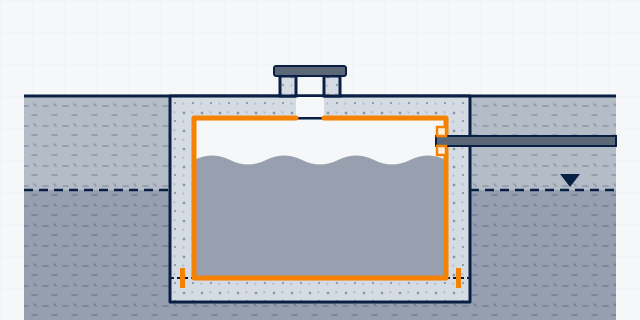
Section of an underground concrete water tank in wet soil, lined on the inside, with joint waterbars and a sealed pipe

Get this solution priced Proposal brief ↓

You need this when…

  • Water level drops overnight with no use
  • Muddy or smelly water, or seepage through the walls when the tank is empty
  • Damp walls, floor or paving next to the tank
  • Leaking cracks or construction joints inside the tank
  • Roots, insects or soil entering through gaps around pipes

The work, step by step

General guidance based on the manufacturer data sheets. Site conditions differ: confirm the system with MCT before you start. Where we do not name a product, ask us and we will confirm the right one.

  1. Step 1: New tanks: watertight concrete and joints

    Before the pour, add a waterproofing admixture: SikaControl-760 lists water tanks and reservoirs (p.1). Cast a Sika Waterbar V-20 L SH into construction joints (reservoirs, p.1), or place SikaSwell S-2 in the centre of the wall with at least 8 cm cover each side; it is not for movement joints (SikaSwell S-2 p.2). Coat the outside face against aggressive soil with Sika Bitumen (p.1). These sit inside or outside the concrete; the drinking-water face is still lined in a later step.

    Sika Waterbar V-20 L SH Sika Request a quotation

    Sika Waterbar® V-20 L SH is used to waterproof construction joints in concrete structures such as those in water retaining structures, including reservoirs, canals, sewage plants, dams, swimming pools etc. (TDS p.1)

    Temperature stated in TDS
    +23°C -35°C (TDS p.2)
    Other options for this stepAsk us

    The right product here depends on your site. We confirm it before naming it.

  2. Step 2: Empty, clean and inspect

    Drain and ventilate the tank before anyone enters. Remove sludge, laitance and old coatings by water jetting or wire brushing (SikaTop-550 Seal p.3). With the tank empty, note where groundwater comes in. If a septic tank or soakaway is close by, have the drainage checked as well.

  3. Step 3: Stop active leaks

    Plug running holes and static cracks with SikaSet Waterplug (NSF/ANSI 61 for potable water contact, p.1). Water-bearing cracks and leaking joints are injected with Sika Injection-306, which works in damp or water-saturated ground (p.1). It is for experienced professionals only (p.1), and nearby drains and open pipes must be checked first (p.2).

    SikaSet Waterplug Sika Request a quotation

    Non-moving (static) cracks and holes with running water or moisture seepage For immersion service For anchoring vertical bolts Basements Foundations Retaining walls Sewers Locations Vertical, overhead, or horizontal Interior or exterior Above or below grade… (TDS p.1)

    Sika Injection-306 Sika Professionals only Request a quotation

    Crack and joint injection Injection of SikaFuko® injection hoses to seal construction joints Sealing water-bearing cracks and voids Sealing all types of leaking building components in damp or water saturated ground conditions Sealing leaks where there is so… (TDS p.1)

    Temperature stated in TDS
    +5 °C min. / +40 °C max (TDS p.2)
  4. Step 4: Repair damaged concrete

    Rebuild spalled or honeycombed areas with a SikaRep or MonoTop repair mortar (SikaTop-550 Seal p.3). Above 35 °C, use chilled mixing water (Sika MonoTop-612 PK p.2). Close blowholes with a pore sealer (SikaRep Fine PK p.1).

    Product for this stepAsk us

    The right product here depends on your site. We confirm it before naming it.

  5. Step 5: Line the inside with a drinking-water coating

    SikaTop-550 Seal (BS 6920, p.1) is breathable and is applied on a pre-dampened surface (p.1, p.3), so it suits walls that stay damp from the soil. Sikagard PW (potable, p.1) must not be applied on substrates with rising moisture (Sikagard PW p.3), so use it only on dry, sound concrete and only by experienced professionals (p.1).

  6. Step 6: Seal joints and pipe entries

    Seal joints and gaps around pipes with Sikaflex PRO-3 WF (BS 6920 drinking water contact, p.1), primed as the data sheet requires for water immersion (p.4). Never use polysulphide sealants (Sika Polysulphide GG p.2) or Sikaflex Tank N (p.1) in a drinking-water tank.

    Sikaflex PRO-3 WF Sika Request a quotation

    Sikaflex® PRO-3 WF is designed for movement and connection joints in floors, pedestrian and traffic areas (e.g. (TDS p.1)

    Temperature stated in TDS
    40 °C min. / +70 °C max (TDS p.2)
  7. Step 7: Cure, disinfect and refill

    Protect the fresh lining from water and condensation as its data sheet requires (Sikagard PW p.3: at least 24 hours). Clean and disinfect to local rules before refilling (Sikagard PW p.3).

Proposal brief

Underground water tank: scope and system

A starting point for a site proposal. Quantities, prices and the final specification follow a site visit or photos.

Scope of work

  1. Dewatering, cleaning and inspection of the tank (internal area in m²)
  2. Plugging and injection of active leaks
  3. Concrete repair and pore sealing
  4. Drinking-water lining to walls, floor and roof slab underside
  5. Sealing of joints and pipe entries
  6. For new tanks: admixture, waterbars or swellable sealant, external bitumen coat

System build-up

StepProductPackSource
1. New tanks: watertight concrete and jointsSikaControl-760SikaControl®-760 is available in 5 Kg & 25 kg pack.TDS p.1 · March 2025, Version 04.01
1. New tanks: watertight concrete and jointsSika Waterbar V-20 L SH—TDS p.1 · May 2021, Version 01.01
3. Stop active leaksSikaSet Waterplug—TDS p.1 · September 2024, Version 02.01
3. Stop active leaksSika Injection-306 (professionals)—TDS p.1 · May 2021, Version 02.01
5. Line the inside with a drinking-water coatingSikaTop-550 Seal—TDS p.1 · March 2024, Version 01.01
5. Line the inside with a drinking-water coatingSikagard PW (professionals)—TDS p.1 · May 2021, Version 02.01
6. Seal joints and pipe entriesSikaflex PRO-3 WF—TDS p.1 · May 2021, Version 02.01

What we need from you

  • Tank size or capacity and depth below ground
  • Photos of the inside with the tank empty, showing any water coming in
  • Distance to the nearest septic tank, soakaway or sewer line
  • Is it a new tank (drawings) or an existing one (age)?
  • Confirm it stores drinking water

Site conditions

  • Tank kept empty and dewatered during the work
  • Safe access and ventilation for work inside the tank
  • Application between +5 °C and +40 °C (SikaTop-550 Seal p.2)

Not included

  • Structural repairs, quoted after an engineer's assessment
  • Septic tank, sewer or drainage repairs
  • Pumps, valves and plumbing
  • Disinfection and water testing to local rules

Questions customers ask

Water seeps in when the tank is empty. Will an inside coating stop it?

Running leaks are first plugged (SikaSet Waterplug p.1) or injected (Sika Injection-306 p.1). The SikaTop-550 Seal data sheet does not state resistance to water pushing from behind, so for a high water table, Ask us: it depends on site conditions.

Can we use SikaTop-107 or SikaSeal-105 inside a drinking-water tank?

Their data sheets list water tanks (SikaTop-107 Seal PK p.1; SikaSeal-105 PK p.1) but do not state drinking-water approval. We use them only for non-drinking tanks, such as fire or irrigation storage. For drinking water we use SikaTop-550 Seal or Sikagard PW (06 F2).

Our tank is next to the septic tank. What should we do?

Fix the drainage first. No coating data sheet covers sewage contamination of a drinking-water tank, and injection also needs a survey of nearby drains and open pipes (Sika Injection-306 p.2). Ask us: it depends on site conditions.

Can a brand-new tank be lined straight away?

SikaTop-550 Seal can be applied to 24-hour-old concrete (p.1). Sikagard PW needs sound concrete of at least 25 N/mm² and no rising moisture (p.3).

Steps and product facts are taken from the manufacturer data sheets (page cited). Products are named only where the data sheet confirms the use; quantities follow a site visit or photos. General guidance: check the data sheet or ask us before you start.