SikaMur® InjectoCream-100 can be used to treat rising damp in almost all types of masonry walls: Solid brick walls, Cavity walls, Random form stone and rubble infill walls, etc. (TDS p.1)
- Temperature stated in TDS
- +5 °C min. / +35 °C max (TDS p.2)


Popular: Sikaflex · waterproofing · grout · data sheets
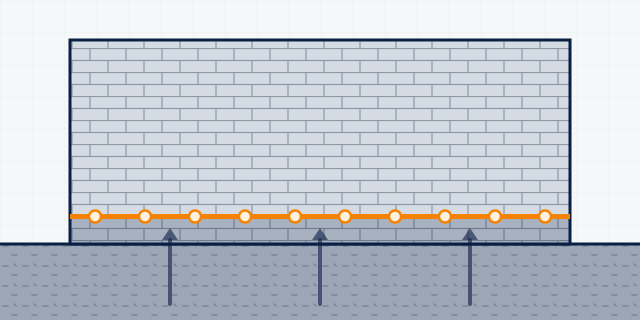
Ground moisture rising up masonry walls that have no damp-proof course, or a failed one, causes seelan, salts and peeling paint near the floor. The fix is a new chemical damp-proof course injected into a mortar joint, followed by re-plastering.
General guidance based on the manufacturer data sheets. Site conditions differ: confirm the system with MCT before you start. Where we do not name a product, ask us and we will confirm the right one.
Rule out leaking pipes, rain splash, a high outside ground level and condensation. Fix those first. Lower the outside ground or paving below floor level where possible.
Remove the skirting and the salt-contaminated plaster to expose the masonry and the mortar course to be treated. Measure each wall's thickness (SikaMur InjectoCream-100 p.3).
Drill 12 mm holes horizontally into one mortar course, no more than 120 mm apart. Drill to within 40 mm of the far face: for example 190 mm deep in a 220 mm wall. Blow each hole clean with dry compressed air (SikaMur InjectoCream-100 p.2).
Back-fill each hole to within 1 cm of the surface using the hand gun. No pump is needed (SikaMur InjectoCream-100 p.1, p.3). The cream spreads in the wall and forms a new damp-proof course (SikaMur InjectoCream-100 p.1). Cavity and rubble-stone walls have their own drilling method (SikaMur InjectoCream-100 p.3).
SikaMur® InjectoCream-100 can be used to treat rising damp in almost all types of masonry walls: Solid brick walls, Cavity walls, Random form stone and rubble infill walls, etc. (TDS p.1)
Plug or fill and point the holes with a suitable mortar (SikaMur InjectoCream-100 p.3). Removing and correctly replacing salt-contaminated plaster is essential. The data sheet names SikaMur Dry mortar (SikaMur InjectoCream-100 p.3), which we do not hold a data sheet for: ask us. Let the wall dry before decorating.
Above ground level only, a clear water repellent on exposed brick or render cuts rain splash and still lets the wall dry out (Sikagard-700 S PK p.1). It is not for below-ground use (Sikagard-700 S PK p.2).
Sikagard®-700 S PK is used as water repellent and colourless protective surface treatment on absorbent exposed materials such as concrete, cementitious rendering, concrete tiles, fibre cement, brickwork (clay and lime sand, non-vitrified), natural stone. (TDS p.1,2)
A starting point for a site proposal. Quantities, prices and the final specification follow a site visit or photos.
| Step | Product | Pack | Source |
|---|---|---|---|
| 4. Inject the damp-proof course | SikaMur InjectoCream-100 | — | TDS p.1 · December 2022, Version 01.01 |
| 6. Reduce splash on the outside plinth | Sikagard-700 S PK | 1000 ltr IBC | TDS p.1,2 · August 2026, Version 01.01 |
As a guide, 10 m of 220 mm wall needs about 3.0 sausages (600 ml), and 10 m of 110 mm wall about 1.5 (SikaMur InjectoCream-100 p.2). Add at least 10 % for site variation (SikaMur InjectoCream-100 p.2).
No. It is injected with a simple hand gun into drilled holes, without pressure (SikaMur InjectoCream-100 p.1).
Some white stains may appear around the holes. Brush them off when dry (SikaMur InjectoCream-100 p.2).
Yes. Random stone and rubble-infill walls are listed, with extra drilling where rubble blocks the holes (SikaMur InjectoCream-100 p.1, p.3).
SikaMur InjectoCream-100 works by forming a damp-proof course inside the mortar joint, not as a surface treatment (SikaMur InjectoCream-100 p.1, p.2). For any other inside treatment, ask us: it depends on site conditions.
Steps and product facts are taken from the manufacturer data sheets (page cited). Products are named only where the data sheet confirms the use; quantities follow a site visit or photos. General guidance: check the data sheet or ask us before you start.