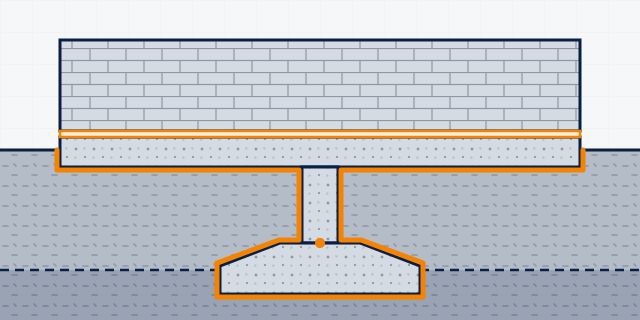
You need this when…
- New construction on a site with high groundwater or salty soil
- Salt and damp marks at plinth level on existing buildings
- Spalling or rust on footings or column stubs uncovered during works
- Ground-floor slab staying damp
The work, step by step
General guidance based on the manufacturer data sheets. Site conditions differ: confirm the system with MCT before you start. Where we do not name a product, ask us and we will confirm the right one.
-
1
Step 1: Check the soil and design
Use the soil report to judge how aggressive the soil and groundwater are, and agree the foundation concrete specification with the engineer.
-
2
Step 2: Watertight foundation concrete
Add a crystalline waterproofing admixture, which lists building basements and foundations, at about 1000 g per 100 kg of cement (SikaControl-760 p.1, p.2). Alternatively, use a liquid waterproofing admixture (Sika-1 PK p.1). Cure well in hot weather (SikaControl-760 p.2).
SikaControl®-760 should be used in all structural concrete that is constantly or intermittently in contact with water such as sea walls, tunnels, basements, structural and precast concrete. SikaControl®-760 can also be used as crystalline waterproofing admixture for cement mortars and plasters. T… (TDS p.1)
- Pack
- SikaControl®-760 is available in 5 Kg & 25 kg pack.
Other options for this stepAsk usThe right product here depends on your site. We confirm it before naming it.
-
3
Step 3: Seal construction joints and pipe entries
Where the footing meets the column or wall, or pipes pass through, use a swelling sealant or profile at the centre of the section (SikaSwell S-2 p.1, p.2; SikaSwell P Profiles p.1).
Joint sealing: Construction joints, Pipe and steel work penetrations through walls and floor slabs, Around all types of penetrations and construction joints, Construction joints in cable ducts, etc. Fixing / Adhering swellable profiles:, SikaSwell® A Profiles, SikaSwell® P Profiles. (TDS p.1)
- Temperature stated in TDS
- +5 °C min. / +35 °C max (TDS p.2)
- Pack
- 600 ml unipacs
To seal: Construction joints, Pipe and steel work penetrations through walls and floor slabs, Construction joints in precast concrete, Construction joints in tunnel segments, Construction joints in cable ducts, etc, Around all types of penetrations through concrete. (TDS p.1)
-
4
Step 4: Coat all buried concrete
Coat footings, column stubs and plinth beams that will be buried with a bituminous coating against aggressive soil, in 2–3 coats (Sika Bitumen p.1, p.2). Alternatively, use a rubberised bitumen emulsion, which can go on damp surfaces (Sika Igasol Emulsion BA-10 p.1, p.2).
To protect concrete surfaces against attack of aggressive soils & subsequent backfills; such as : Retaining walls, Basements, Columns, Foundations. (TDS p.1)
- Pack
- 14 Kg pails
Sika Igasol Emulsion BA-10 Sika
Request a quotation
Sika® Igasol® Emulsion BA-10 is used for: Tanking and waterproofing of substructures to provide an impervious membrane, Vapour barrier of cladded walls, Maintenance of many roof types including asphaltfelt roofs, concrete, cement, lightweight screeds, timber etc, As an adhesive for bonding insula… (TDS p.1)
- Temperature stated in TDS
- -10 °C min. / +85 °C max (TDS p.2)
-
5
Step 5: Damp-proof course at plinth level
Make the plinth or damp-proof-course mortar and concrete waterproof with an integral admixture (Sika-1 PK p.1; Sikalite-101 PK p.1). Under the ground-floor slab, a bitumen emulsion can act as a damp-proof membrane for floor slabs (Sika Igasol Emulsion BA-10 p.1).
Sika Igasol Emulsion BA-10 is used again here; data and quotation in step 4. Go to step 4
Other options for this stepAsk usThe right product here depends on your site. We confirm it before naming it.
-
6
Step 6: Backfill
Let the coatings dry, then backfill in layers without damaging them. Where a screed covers Sika Bitumen, blind the last coat with clean dry sand (Sika Bitumen p.2).
Proposal brief
Foundations, footings and plinth: scope and system
A starting point for a site proposal. Quantities, prices and the final specification follow a site visit or photos.
Scope of work
- Waterproofing admixture for foundation and plinth concrete
- Swelling seals at joints and pipe entries
- Bituminous protective coating on x m² of buried concrete
- Waterproofed damp-proof course at plinth level
- Inspection before backfilling
System build-up
| Step | Product | Pack | Source |
|---|
| 2. Watertight foundation concrete | SikaControl-760 | SikaControl®-760 is available in 5 Kg & 25 kg pack. | TDS p.1 · March 2025, Version 04.01 |
| 3. Seal construction joints and pipe entries | SikaSwell S-2 | 600 ml unipacs | TDS p.1 · May 2021, Version 02.01 |
| 3. Seal construction joints and pipe entries | SikaSwell P Profiles | — | TDS p.1 · May 2021, Version 01.01 |
| 4. Coat all buried concrete | Sika Bitumen | 14 Kg pails | TDS p.1 · May 2021, Version 01.01 |
| 4. Coat all buried concrete | Sika Igasol Emulsion BA-10 | — | TDS p.1 · May 2021, Version 01.01 |
| 5. Damp-proof course at plinth level | Sika Igasol Emulsion BA-10 | — | TDS p.1 · May 2021, Version 01.01 |
What we need from you
- Foundation drawings and number of footings and columns
- Soil report (sulphates, chlorides, water table)
- Construction programme and concrete supplier
- Ground-floor level compared with outside ground
Site conditions
- Dry excavation during coating
- No rain while bitumen emulsion cures (Sika Igasol Emulsion BA-10 p.2)
- Engineer-approved concrete mix
Not included
- Excavation, dewatering and backfilling
- Structural design
- Termite treatment
Questions customers ask
Do footings really need a coating if the concrete has an admixture?
The admixture improves the concrete's resistance to water ingress (SikaControl-760 p.1). A bituminous coating adds protection against aggressive soils and backfill (Sika Bitumen p.1). Whether you need both depends on the soil report: ask us.
How much bitumen coating is needed?
Sika Bitumen uses about 0.4–0.6 kg/m² for 2 coats, depending on how porous the concrete is (Sika Bitumen p.1).
Can the bitumen go on damp concrete?
Sika Igasol Emulsion BA-10 can go on damp but not waterlogged surfaces (Sika Igasol Emulsion BA-10 p.2). Sika Bitumen needs surfaces free of standing water (Sika Bitumen p.2).
Steps and product facts are taken from the manufacturer data sheets (page cited). Products are named only where the data sheet confirms the use; quantities follow a site visit or photos. General guidance: check the data sheet or ask us before you start.