

- Temperature stated in TDS
- +5°C min. / +40°C max (TDS p.2)
Step-by-step solution
Exposed roof waterproofing
A liquid-applied membrane that stays open to sun and rain on a flat or sloped concrete roof (chhat). Use it on a new roof once the slab is 28 days old, or to refurbish a leaking roof before the monsoon.
- 6 steps
- 8 products
- 6 answers
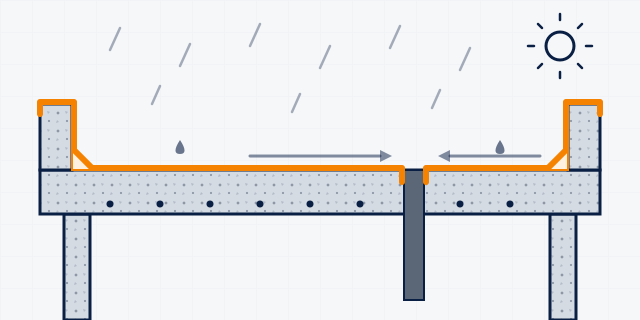
How the system works
The problem, and the system that solves it
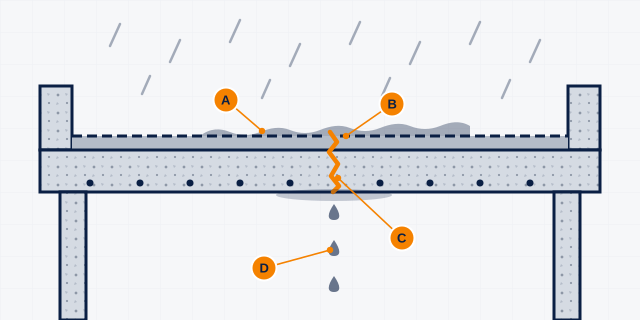
What goes wrong
- A: Water stands on the roof after rain because the falls to the outlet are poor. Standing water keeps pressing on every weak spot.
- B: The old coating has aged, cracked or lifted, so it no longer forms a closed skin.
- C: Hairline cracks and the slab-to-parapet junction give the water a path through the concrete.
- D: The water comes out as damp patches and drips on the top-floor ceiling, often far from where it entered.
How the system works
A liquid-applied membrane cures into one seamless, elastic skin with no laps or joints for water to find. It stays flexible, so it bridges hairline cracks, and it resists sun and rain. At corners, upstands and joints it is reinforced with a fleece so movement does not tear it.
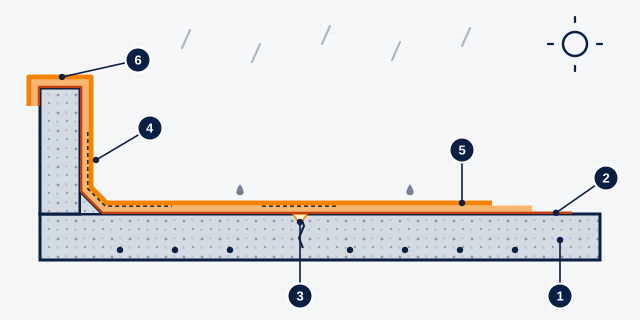
The system, layer by layer
-
Layer 1: Sound, clean, dry slab
What it does: The base the system bonds to.
Why it is needed here: Loose, dusty or damp concrete makes any coating peel. Remove old loose coatings, repair weak areas and let the slab dry.
-
Layer 2: Primer
What it does: Soaks into the surface, binds dust and gives the membrane a firm grip.
Why it is needed here: Without it the membrane bonds only to surface dust and can lift. Use the primer that the chosen membrane's data sheet names.
- Sika Bonding Primer TDS: two-part water-based primer for 'Sikalastic roofing systems'; 'Consolidates dusty or friable surfaces' (p.1)
-
Layer 3: Crack sealing before waterproofing
What it does: Fills and seals cracks in the slab.
Why it is needed here: The membrane bridges hairline movement, but open cracks must be filled first so the coat stays continuous.
- Sikadur-20 Crack Seal TDS: fills and seals non-structural cracks in 'concrete roof structures … especially before waterproofing works' (p.1)
-
Layer 4: Reinforcing fleece at corners, joints and cracks
What it does: A fabric embedded in the wet membrane at the weak points.
Why it is needed here: Corners, upstands and joints move the most; the fleece spreads the strain so the membrane does not split there.
- Sika Reemat Premium Sikalastic-560 GCC TDS: 'Sika Reemat Premium can be applied at areas with high movements … to bridge cracks, joints and seams … as well as for details' (Sikalastic-560 GCC p.3)
-
Layer 5: Liquid membrane, two coats
What it does: The waterproof, UV-resistant skin.
Why it is needed here: Two coats give full thickness with no thin spots or pinholes. Choose the membrane by roof use: ponding, refurbishment or new build.
- Sikalastic-510 PK TDS: 'Exposed roof waterproofing'; 'Impervious coating on roofs (flat & sloped)' (p.1)
- Sika Raingard TDS: acrylic waterproofing membrane 'for all types of exposed roof slabs (new and old), terraces'; UV and weather resistant (p.1)
- Sikalastic-560 GCC TDS: 'For exposed roof waterproofing solutions in both new construction and refurbishment projects'; reflective coating (p.1)
- Sikalastic-590 TDS: roof waterproofing for new and refurbishment projects (p.1); 'can be applied on roofs subject to short ponding water' (p.3)
-
Layer 6: Turned up and over the parapet
What it does: The membrane runs up the coved upstand and over the parapet top; metal parts are primed.
Why it is needed here: Most roof leaks start at junctions. Carrying the membrane over the upstand closes the edge; metal needs its own anti-corrosive primer.
- Sikalastic Metal Primer TDS: anti-corrosive primer on metal substrates for 'Sikalastic roofing systems'; barrier against bitumen migration (p.1)
Common mistakes to avoid
- Applying the 510 PK or Raingard membranes on roofs that people walk on: their data sheets limit them to non-trafficked areas (Sikalastic-510 PK p.1; Sika Raingard p.1).
- Using Sikalastic-560 GCC where water ponds for a long time or where moisture rises from below (Sikalastic-560 GCC p.3).
- Coating when rain is due within 24 hours, or Sikalastic-590 on slopes below about 1 % (Sikalastic-590 p.3).
- Using the metal primer indoors or on wet metal (Sikalastic Metal Primer p.2).
Products are named only where the data sheet confirms the use (verified); other layers say "Ask us". Diagrams are schematic, not to scale. Draft pending technical sign-off.
You need this when…
- Damp patches or dripping on the top-floor ceiling after rain
- Hairline cracks across the slab or along the slab-parapet junction
- Water standing on the roof for hours after rain
- Old roof coating peeling, blistered or chalky
- Top-floor rooms very hot in summer
The work, step by step
General guidance based on the manufacturer data sheets. Site conditions differ: confirm the system with MCT before you start. Where we do not name a product, ask us and we will confirm the right one.
-
Step 1: Inspect the roof and its drainage
Find where water gets in: cracks, joints, the parapet junction, drain outlets and pipe entries. Clear the drains and mark where water ponds. Sikalastic-560 GCC is not for roofs with long-term ponding (Sikalastic-560 GCC p.3). Sikalastic-590 accepts short ponding and needs about a 1 % fall (Sikalastic-590 p.3).
-
Step 2: Prepare the slab
Remove dust, loose material, failed coatings and any tile glaze by mechanical means or a high-pressure water jet. The concrete must be sound, at least 25 N/mm² with 1.5 N/mm² pull-off (Sikalastic-510 PK p.2). New concrete must be cured for at least 28 days (Sikalastic-560 GCC p.4). On dusty or friable surfaces, use a two-part primer that consolidates the surface (Sika Bonding Primer p.1).
Sika Bonding Primer Sika Request a quotation -
Step 3: Seal cracks and repair damaged concrete
Groove and fill non-structural cracks up to 10 mm wide in concrete at least 28 days old (Sikadur-20 Crack Seal p.2). Rebuild spalled patches with a repair mortar (SikaRep PK p.1). If a crack is moving or the slab sags, get an engineer's assessment first.
Sikadur-20 Crack Seal Sika Request a quotation To fill and seal non-structural crack and cavities in structural concrete such as concrete decks, balconies, concrete roof structures, wet room, swimming pool and especially before waterproofing works. (TDS p.1)
- Pack
- 160 mL and 850 mL set
Other options for this stepAsk us The right product here depends on your site. We confirm it before naming it.
-
Step 4: Detail joints, upstands and metal parts
Do all details before the main area (Sikalastic-560 GCC p.4). Seal movement and connection joints with an elastic sealant over a backer rod (Sikaflex Construction AP p.1, p.3). Bed a reinforcement fleece over cracks, joints and parapet corners when using Sikalastic-560 GCC (Sikalastic-560 GCC p.3). Prime metal railings, pipes and flashings with an anti-corrosive primer, which is for outdoor use only (Sikalastic Metal Primer p.1, p.2).
Sika Reemat Premium Sika Request a quotation For the exposed roof systems SikaRoof® MTC 12, 15, 18 and 22 For SikaRoof® MTC Flashing and MTC Detailing For covered roof systems SikaRoof® MTC Green and SikaRoof® MTC Ballast For new construction and refurbishment projects For roofs with many details and … (TDS p.1)
- Pack
- - 1.3 m wide by 90m - 0.3 m wide by 150m
Sikalastic Metal Primer Sika Request a quotation Versatile and anti-corrosive primer on metal substrates for use with: SikaRoof® MTC, Sikalastic® roofing systems, Sikafloor® balcony waterproofing systems, Sikagard® hygiene coatings Barrier against migration of volatile bitumen or plasticizer migration. (TDS p.1)
- Temperature stated in TDS
- +5 °C min. / +40 °C max (TDS p.2)
Other options for this stepAsk us The right product here depends on your site. We confirm it before naming it.
-
Step 5: Apply the liquid membrane
Choose one system. Sikalastic-510 PK or Sika Raingard: prime, then apply 2–3 coats, with Sika Fab-1 glass-fibre mesh laid into the tacky first coat and 24 hours between coats (Sikalastic-510 PK p.2; Sika Raingard p.3). Sikalastic-560 GCC: prime with the product diluted with 10 % water, then apply 2–6 coats, no more than 0.35 kg/m² per unreinforced coat (Sikalastic-560 GCC p.2, p.4). Sikalastic-590 is for roofs that see short ponding (Sikalastic-590 p.3).
Sikalastic-510 PK Sika Sikalastic®-510 PK have following uses: Exposed roof waterproofing, Impervious coating on roofs (flat & sloped) and concrete structures, As protective coating in infrastructure projects, On non-trafficked areas, Excellent adhesion to concrete, brickwork, corrugated asbestos and asbestos cement sh… (TDS p.1)
- Temperature stated in TDS
- +10°C min / +40°C max (TDS p.2)
Sika Raingard Sika - Temperature stated in TDS
- +5°C-30°C (TDS p.1)
- Pack
- Sika® Raingard:4.5kg, 18kg and 200kg
Sikalastic-560 GCC Sika Request a quotation For exposed roof waterproofing solutions in both new construction and refurbishment projects For exposed roofs with many details and complex geometry when accessibility is limited For cost efficient life cycle extension of failing exposed roofs For reflecti… (TDS p.1)
- Temperature stated in TDS
- -10 °C min. / +80 °C max (TDS p.2)
Sikalastic-590 Sika Request a quotation For waterproofing solutions in both new construction and refurbishment projects For roofs with many details and complex geometry when accessibility is limited For cost efficient life cycle extension of failing roofs For reflective coating to enhance energy … (TDS p.1)
- Temperature stated in TDS
- +15 °C min / +35 °C max (TDS p.2)
-
Step 6: Cure, check and hand over
Keep everyone off the roof while it cures. Each coat must be dry and free of pinholes before the next (Sikalastic-560 GCC p.3). Once fully cured, a Sikalastic-560 GCC roof may be flood-tested with 50 mm of water for up to 24 hours (Sikalastic-560 GCC p.3).
Proposal brief
Exposed roof waterproofing: scope and system
A starting point for a site proposal. Quantities, prices and the final specification follow a site visit or photos.
Scope of work
- Leak, drain and ponding survey
- Surface preparation of x m² roof slab
- Crack sealing and minor concrete repair
- Detailing of joints, parapet upstands, outlets and pipe entries
- Exposed liquid membrane, 2–3 coats with reinforcement
- Flood test where the chosen system allows
System build-up
| Step | Product | Pack | Source |
|---|---|---|---|
| 2. Prepare the slab | Sika Bonding Primer | — | TDS p.1 |
| 3. Seal cracks and repair damaged concrete | Sikadur-20 Crack Seal | 160 mL and 850 mL set | TDS p.1 · March 2025, Version 03.02 |
| 4. Detail joints, upstands and metal parts | Sika Reemat Premium | - 1.3 m wide by 90m - 0.3 m wide by 150m | TDS p.1 |
| 4. Detail joints, upstands and metal parts | Sikalastic Metal Primer | — | TDS p.1 · December 2022, Version 01.01 |
| 5. Apply the liquid membrane | Sikalastic-510 PK | — | TDS p.1 · June 2025, Version 03.01 |
| 5. Apply the liquid membrane | Sika Raingard | Sika® Raingard:4.5kg, 18kg and 200kg | TDS p.1 |
| 5. Apply the liquid membrane | Sikalastic-560 GCC | — | TDS p.1 · December 2022, Version 02.01 |
| 5. Apply the liquid membrane | Sikalastic-590 | — | TDS p.1 · March 2026, Version 02.01 |
What we need from you
- Roof area (m² / sq ft) and parapet length
- Photos of the roof, parapets, drains and ceiling stains
- Age of the slab and any existing coating or bitumen layer
- Will people walk on the roof? Are there tanks or solar panels on it?
- Is roof heat a concern (white reflective option)?
Site conditions
- Dry weather, with no rain until the coat is rain-resistant (Sikalastic-560 GCC p.3)
- Slab at least 28 days old (Sikalastic-560 GCC p.4)
- Clear roof access, water and electricity on site
Not included
- Structural repairs and re-sloping screeds are quoted separately after inspection
- Moving and refixing tanks, solar panels or equipment
- Paving or tiles over the membrane
Questions customers ask
Can we walk on the roof after coating?
Only for occasional maintenance. Sikalastic-510 PK is for non-trafficked areas (Sikalastic-510 PK p.1). Sikalastic-560 GCC is not for pedestrian traffic and should be covered with paving where traffic cannot be avoided (Sikalastic-560 GCC p.3). For a roof used as a terrace, see the terrace-balcony guide.
Will a white roof coating reduce heat?
Sikalastic-560 GCC is designed as a reflective coating to reduce cooling costs, with a Solar Reflectance Index of 93.24 to ASTM E 1980 (Sikalastic-560 GCC p.1, p.2). The saving in your building depends on site conditions: ask us.
Can it go over our old bitumen layer?
Sikalastic-560 GCC can, if the bituminous felt is firmly bonded, not badly degraded, and primed first (Sikalastic-560 GCC p.4). Sikalastic Metal Primer also acts as a barrier against bitumen migration (Sikalastic Metal Primer p.1).
Water stands on my roof after rain. What should I use?
Sikalastic-560 GCC should not be used where water ponds long-term (Sikalastic-560 GCC p.3). Sikalastic-590 accepts short ponding on a 1 % slope (Sikalastic-590 p.3). A badly ponding roof needs a re-sloping screed first: ask us.
How soon can it rain after coating?
Sikalastic-560 GCC is rain-resistant after about 4 hours at +30 °C or 12 hours at +10 °C, and fully cured after about 2–6 days (Sikalastic-560 GCC p.3).
Can the coating be coloured?
Sikalastic-510 PK can be tinted to light shades with a good-quality stainer, after a site trial for colour consistency (Sikalastic-510 PK p.2).
Steps and product facts are taken from the manufacturer data sheets (page cited). Products are named only where the data sheet confirms the use; quantities follow a site visit or photos. General guidance: check the data sheet or ask us before you start.