
Bonding primer as part of a concrete repair system Reinforcement corrosion protection as part of a concrete repair system (TDS p.1)
Step-by-step solution
Parapets, copings and chajjas
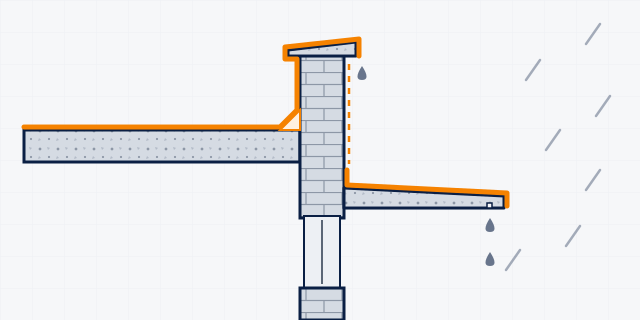
Parapet walls, copings and chajjas (concrete sunshades and projections) take rain on three sides. Leaks here show up as damp on the walls below, broken edges and rust stains.
- 5 steps
- 5 products
- 4 answers
You need this when…
- Crack along the joint between the roof slab and the parapet
- Damp at the top of internal walls just below the roof
- Chajja edge broken off, with rusty steel showing
- Black streaks of algae below the coping or chajja
- Water running back under the chajja instead of dripping clear
The work, step by step
General guidance based on the manufacturer data sheets. Site conditions differ: confirm the system with MCT before you start. Where we do not name a product, ask us and we will confirm the right one.
-
Step 1: Inspect and make safe
Tap the concrete to find hollow areas. Check the slab-parapet crack, the slope of the coping and chajja tops, and the drip groove underneath. A chajja that is cracked at its root or sagging needs an engineer's assessment before any repair.
-
Step 2: Repair spalled concrete and rusted steel
Break out loose concrete and clean the rusted bars. Apply a bonding primer and rebar protection, which is for experienced professionals only (Sika MonoTop-610 p.1). Rebuild with a repair mortar for spalled concrete (SikaRep PK p.1), or with one suited to overhead and vertical work such as chajja soffits (Sika MonoTop-612 PK p.1).
Sika MonoTop-610 Sika Professionals only Sika MonoTop-612 PK Sika Sika MonoTop®-612 PK is used for structural concrete repairs as well as general patching to concrete and mortars. (TDS p.1)
Other options for this stepAsk us The right product here depends on your site. We confirm it before naming it.
-
Step 3: Seal cracks and the slab-parapet joint
Fill non-structural cracks up to 10 mm (Sikadur-20 Crack Seal p.2). The slab-parapet junction moves, so treat it as a joint: backer rod plus an elastic sealant for movement and connection joints (Sikaflex Construction AP p.1, p.3).
Product for this stepAsk us The right product here depends on your site. We confirm it before naming it.
-
Step 4: Waterproof the tops
Coat the coping top, the inside face of the parapet and the chajja top with an exposed, crack-bridging membrane (Sikalastic-510 PK p.1; Sika Raingard p.1). Alternatively, continue the roof's Sikalastic-560 GCC up and over the parapet, reinforced at the junction (Sikalastic-560 GCC p.3).
Sika Reemat Premium Sika Request a quotation For the exposed roof systems SikaRoof® MTC 12, 15, 18 and 22 For SikaRoof® MTC Flashing and MTC Detailing For covered roof systems SikaRoof® MTC Green and SikaRoof® MTC Ballast For new construction and refurbishment projects For roofs with many details and … (TDS p.1)
- Pack
- - 1.3 m wide by 90m - 0.3 m wide by 150m
Other options for this stepAsk us The right product here depends on your site. We confirm it before naming it.
-
Step 5: Protect the wall faces
On exposed brick, concrete or render, apply a clear water-repellent impregnation that lets the wall breathe (Sikagard-700 S PK p.1). Over repaired concrete, an elastic crack-bridging coat can be applied (Sikagard-550 W Elastic p.1; Sika MonoTop-612 PK p.2).
Sikagard-700 S PK Sika Sikagard®-700 S PK is used as water repellent and colourless protective surface treatment on absorbent exposed materials such as concrete, cementitious rendering, concrete tiles, fibre cement, brickwork (clay and lime sand, non-vitrified), natural stone. (TDS p.1,2)
- Temperature stated in TDS
- +5 °C min. / +30 °C max (TDS p.2)
- Pack
- 1000 ltr IBC
Sikagard-550 W Elastic Sika Request a quotation Sikagard®-550 W Elastic is used for protection and enhancement of concrete structures (normal and lightweight concrete), especially exposed outdoor concrete surfaces with a risk of cracking. (TDS p.1)
- Temperature stated in TDS
- +8°C min. / +35°C max (TDS p.3)
- Pack
- 15 l oval plastic pail
Proposal brief
Parapets, copings and chajjas: scope and system
A starting point for a site proposal. Quantities, prices and the final specification follow a site visit or photos.
Scope of work
- Inspection and hammer test of parapets and chajjas (x running metres)
- Concrete repair with rebar treatment where needed
- Crack sealing and slab-parapet joint sealing
- Exposed waterproofing over copings and chajja tops
- Water-repellent or elastic protective coating on faces
System build-up
| Step | Product | Pack | Source |
|---|---|---|---|
| 2. Repair spalled concrete and rusted steel | Sika MonoTop-610 (professionals) | — | TDS p.1 · May 2021, Version 01.01 |
| 2. Repair spalled concrete and rusted steel | Sika MonoTop-612 PK | — | TDS p.1 · October 2023, Version 01.02 |
| 4. Waterproof the tops | Sika Reemat Premium | - 1.3 m wide by 90m - 0.3 m wide by 150m | TDS p.1 |
| 5. Protect the wall faces | Sikagard-700 S PK | 1000 ltr IBC | TDS p.1,2 · August 2026, Version 01.01 |
| 5. Protect the wall faces | Sikagard-550 W Elastic | 15 l oval plastic pail | TDS p.1 · May 2021, Version 01.01 |
What we need from you
- Length of parapet and number and size of chajjas
- Photos of cracks, broken edges and the damp walls inside
- Building height and scaffolding access
- Paint or finish on the outside walls now
Site conditions
- Safe scaffolding or rope access
- Dry weather for sealants and coatings
- Repaired concrete cured before coating (Sikagard-550 W Elastic p.3)
Not included
- Structural redesign or rebuilding of chajjas, which is quoted after an engineer's report
- Scaffolding hire, unless agreed
- Repainting of whole elevations
Questions customers ask
Why is the top of my inside wall damp?
A common route is the crack between the slab and the parapet, or a coping top with no fall. Sealing that junction as a movement joint (Sikaflex Construction AP p.1) and carrying the roof membrane over the parapet deals with both. The exact route needs an inspection: ask us.
Will the clear water repellent change the look of the wall?
It is colourless, but on some stones it can darken the surface slightly, so test a small area first (Sikagard-700 S PK p.1, p.2).
Can we paint over it?
Sikagard-700 S PK cannot be overcoated with limewash or cement paint (Sikagard-700 S PK p.2). It can be used as a water-repellent primer under solvent-based or emulsion protective coatings (Sikagard-700 S PK p.1).
The chajja steel is rusty. Is it safe?
Ask us: it depends on site conditions. An engineer must assess loss of steel and cracking at the root before repair.
Steps and product facts are taken from the manufacturer data sheets (page cited). Products are named only where the data sheet confirms the use; quantities follow a site visit or photos. General guidance: check the data sheet or ask us before you start.