To fill and seal non-structural crack and cavities in structural concrete such as concrete decks, balconies, concrete roof structures, wet room, swimming pool and especially before waterproofing works. (TDS p.1)
- Pack
- 160 mL and 850 mL set


Popular: Sikaflex · waterproofing · grout · data sheets
Waterproofing that is hidden under a protective screed, brick tiles or floor tiles on a flat roof. Use it when you re-do a traditional roof finish or turn the roof into a usable terrace.
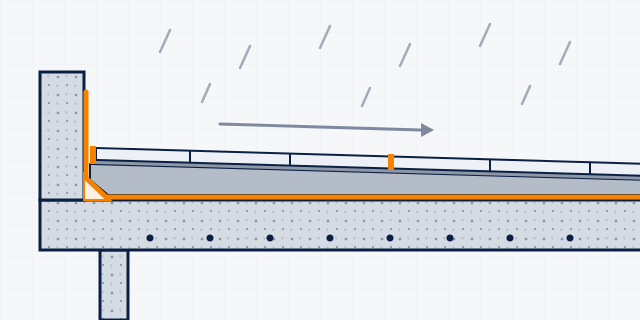
General guidance based on the manufacturer data sheets. Site conditions differ: confirm the system with MCT before you start. Where we do not name a product, ask us and we will confirm the right one.
Remove failed tiles and topping down to the slab. Check the slab for cracks, check the falls to the drains and clear the outlets. Concrete must be at least 28 days old before tiling (SikaCeram-205 PK p.2).
Groove, clean and fill non-structural cracks up to 10 mm wide before waterproofing. The data sheet lists roof structures (Sikadur-20 Crack Seal p.1, p.2).
To fill and seal non-structural crack and cavities in structural concrete such as concrete decks, balconies, concrete roof structures, wet room, swimming pool and especially before waterproofing works. (TDS p.1)
Cement-based option: wet the slab, then apply at least 2 coats of about 1 kg/m² each, never more than 2 kg/m² per coat. Use 3 coats where water penetration is severe (SikaTop-107 Seal PK p.2, p.3). Bitumen option: a rubberised emulsion used as a damp-proof membrane for roofs, in 2–3 coats (Sika Igasol Emulsion BA-10 p.1, p.2), or a bitumen emulsion in at least 2 coats (Sika Bitumen AE p.1, p.2). Carry the layer up the parapet and into the drain outlets.
For external and internal waterproofing, on concrete, mortar, brickwork, and steel in: Basements, Swimming pools, Water tanks, Flat roofs, Balconies, terraces, Bridges. (TDS p.1)
Sika® Igasol® Emulsion BA-10 is used for: Tanking and waterproofing of substructures to provide an impervious membrane, Vapour barrier of cladded walls, Maintenance of many roof types including asphaltfelt roofs, concrete, cement, lightweight screeds, timber etc, As an adhesive for bonding insula… (TDS p.1)
Protect SikaTop-107 Seal PK from direct sun and wind with damp hessian or plastic sheet, and keep rain off it for about 6 hours (SikaTop-107 Seal PK p.3). Where a screed follows a bitumen coat, blind the fresh top coat with clean sharp sand to give a key (Sika Bitumen AE p.2).
Where it is exposed to UV, SikaTop-107 Seal PK needs 2–3 cm of cement screed on top, laid on a bonding coat (SikaTop-107 Seal PK p.2). Waterproof the screed mortar with Sikalite-101 PK at 2 % of the cement weight (Sikalite-101 PK p.2) or with Sika-1 PK (Sika-1 PK p.1, p.2). For a bonding bridge, mix SikaLatex PK with cement and sand. Never brush it on neat (SikaLatex PK p.2).
The right product here depends on your site. We confirm it before naming it.
Fix outdoor floor tiles with a flexible cement adhesive once the screed is 28 days old (SikaCeram-205 PK p.1, p.2). Leave movement joints at the perimeter and between bays, and seal them with a floor sealant rated for pedestrian areas (Sikaflex PRO-3 p.1).
The right product here depends on your site. We confirm it before naming it.
A starting point for a site proposal. Quantities, prices and the final specification follow a site visit or photos.
| Step | Product | Pack | Source |
|---|---|---|---|
| 2. Seal cracks | Sikadur-20 Crack Seal | 160 mL and 850 mL set | TDS p.1 · March 2025, Version 03.02 |
| 3. Apply the waterproofing layer | SikaTop-107 Seal PK | — | TDS p.1 · May 2026, Version 03.02 |
| 3. Apply the waterproofing layer | Sika Igasol Emulsion BA-10 | — | TDS p.1 · May 2021, Version 01.01 |
| 3. Apply the waterproofing layer | Sika Bitumen AE | — | TDS p.1 |
SikaTop-107 Seal PK names Sika TileFix-200 TA within 48 hours for this (SikaTop-107 Seal PK p.2). We do not hold that data sheet, so ask us. The route on file is a 2–3 cm screed over the waterproofing (SikaTop-107 Seal PK p.2), then tiles once the screed is 28 days old (SikaCeram-205 PK p.2).
Sikalastic-560 GCC is mainly for exposed roofs and not for buried systems. Tile mortar must not be applied directly on it (Sikalastic-560 GCC p.3).
At least 2 coats for waterproofing or damp-proofing, and 3 where water penetration is severe (SikaTop-107 Seal PK p.2).
Yes, on damp but not waterlogged surfaces. Prime hot, very dry, porous concrete first with the emulsion diluted 1:1 with water (Sika Igasol Emulsion BA-10 p.2).
Ask us: it depends on site conditions.
Steps and product facts are taken from the manufacturer data sheets (page cited). Products are named only where the data sheet confirms the use; quantities follow a site visit or photos. General guidance: check the data sheet or ask us before you start.