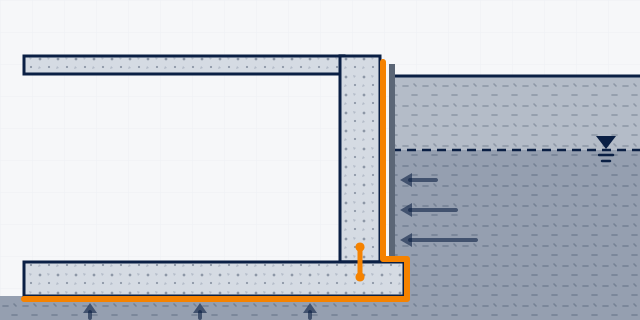
You need this when…
- New house with a basement planned below a high monsoon water table
- Damp or leaks at the wall-floor joint or wall construction joints
- Water entering around pipes and cables through the walls
- Efflorescence and wet patches on basement walls
- Aggressive or salty soil reported by the soil test
The work, step by step
General guidance based on the manufacturer data sheets. Site conditions differ: confirm the system with MCT before you start. Where we do not name a product, ask us and we will confirm the right one.
-
1
Step 1: Plan with the engineer
Confirm the groundwater level, soil report, drainage and joint layout with the structural engineer. Decide where the construction joints and expansion joints go before any concrete is poured.
-
2
Step 2: Make the concrete watertight
Add a crystalline waterproofing admixture, about 1000 g per 100 kg of cement (SikaControl-760 p.1, p.2), or a liquid waterproofing admixture (Sika-1 PK p.1). Cure properly, especially in hot, windy weather (SikaControl-760 p.2).
SikaControl®-760 should be used in all structural concrete that is constantly or intermittently in contact with water such as sea walls, tunnels, basements, structural and precast concrete. SikaControl®-760 can also be used as crystalline waterproofing admixture for cement mortars and plasters. T… (TDS p.1)
- Pack
- SikaControl®-760 is available in 5 Kg & 25 kg pack.
Sika-1 PK Sika
Request a quotation
Sika®-1 PK is used for waterproofing of mortars and concrete, in particular for: Renders, masonry mortars and screeds, Reinforced and unreinforced concrete, Brick, concrete and stone substrates, Indoor and outdoor applications, such as basements, swimming pools, tunnels, water tanks, manholes, cu… (TDS p.1)
- Pack
- 05 ltr jerry can 20 ltr plastic can 200 ltr drum 1000 ltr IBC Bulk supply in tanker is…
-
3
Step 3: Seal construction joints and penetrations
Cast a PVC waterbar into the centre of construction joints (Sika Waterbar V-20 L SH p.1, p.2). Alternatively, use a swelling sealant or profile at the centre of the wall with at least 8 cm cover in reinforced concrete (SikaSwell S-2 p.2) or a swelling profile for water pressure up to 2 bar (SikaSwell P Profiles p.3). Fit the same around pipe sleeves.
Sika Waterbar V-20 L SH Sika
Request a quotation
Sika Waterbar® V-20 L SH is used to waterproof construction joints in concrete structures such as those in water retaining structures, including reservoirs, canals, sewage plants, dams, swimming pools etc. (TDS p.1)
- Temperature stated in TDS
- +23°C -35°C (TDS p.2)
Joint sealing: Construction joints, Pipe and steel work penetrations through walls and floor slabs, Around all types of penetrations and construction joints, Construction joints in cable ducts, etc. Fixing / Adhering swellable profiles:, SikaSwell® A Profiles, SikaSwell® P Profiles. (TDS p.1)
- Temperature stated in TDS
- +5 °C min. / +35 °C max (TDS p.2)
- Pack
- 600 ml unipacs
To seal: Construction joints, Pipe and steel work penetrations through walls and floor slabs, Construction joints in precast concrete, Construction joints in tunnel segments, Construction joints in cable ducts, etc, Around all types of penetrations through concrete. (TDS p.1)
-
4
Step 4: Seal expansion joints
Cast an expansion-joint waterbar into the centre of the section (Sika Waterbar O-20 SH p.1, p.2). For joints with settlement or remedial sealing, use the bonded tape system laid in epoxy adhesive (Sikadur-Combiflex SG-20 P p.1, p.3), which is for experienced professionals (Sikadur-31 DW p.1).
Sika Waterbar O-20 SH Sika
Request a quotation
Sika Waterbar® O-20 SH are used to waterproof expansion joints in concrete structures such as those in water retaining structures, including reservoirs, canals, sewage plants, dams, swimming pools etc. (TDS p.1)
- Temperature stated in TDS
- 35°C to +55°C (TDS p.2)
- Pack
- 15 m rolls
Sikadur-Combiflex SG-20 P Sika
Request a quotation
Sikadur-Combiflex® SG-20 P is used for sealing: Movement joints, Construction joints, Pipe penetrations, Cracks, Building components where differential settlement is expected Sikadur-Combiflex® SG-20 P is used for the following areas:, Tunnels. (TDS p.1)
- Temperature stated in TDS
- +40 °C -30 °C (TDS p.2)
Sikadur-31 DW Sika
Professionals only Request a quotation
Structural adhesive for bonding: Concrete elements, Hard natural stone, Ceramics, fibre cement, Mortar, Bricks, Masonry, Steel, Iron, Aluminium, Wood. (TDS p.1)
- Temperature stated in TDS
- +10 °C to +30 °C (TDS p.1)
-
5
Step 5: Coat the outside face
Fill tie holes and blowholes, and remove laitance. Then apply a rubberised bitumen tanking membrane in 2–3 coats on a damp but not waterlogged face (Sika Igasol Emulsion BA-10 p.1, p.2), or a cement-based slurry in at least 2 coats (SikaTop-107 Seal PK p.1, p.2). Where the soil is aggressive, add a solvent-based bitumen coat (Sika Bitumen p.1).
Sika Igasol Emulsion BA-10 Sika
Request a quotation
Sika® Igasol® Emulsion BA-10 is used for: Tanking and waterproofing of substructures to provide an impervious membrane, Vapour barrier of cladded walls, Maintenance of many roof types including asphaltfelt roofs, concrete, cement, lightweight screeds, timber etc, As an adhesive for bonding insula… (TDS p.1)
- Temperature stated in TDS
- -10 °C min. / +85 °C max (TDS p.2)
For external and internal waterproofing, on concrete, mortar, brickwork, and steel in: Basements, Swimming pools, Water tanks, Flat roofs, Balconies, terraces, Bridges. (TDS p.1)
- Temperature stated in TDS
- +5 °C min. / +35 °C max (TDS p.2)
To protect concrete surfaces against attack of aggressive soils & subsequent backfills; such as : Retaining walls, Basements, Columns, Foundations. (TDS p.1)
- Pack
- 14 Kg pails
-
6
Step 6: Sheet membrane for larger projects
For large basements, a glass-fibre reinforced sheet membrane against groundwater can be used (Sikaplan WT 1200-16 C p.1). It must be installed by Sika-trained contractors only (Sikaplan WT 1200-16 C p.3).
Sikaplan WT 1200-16 C Sika
Request a quotation
Waterproofing of basements and cut-and-cover structures against groundwater (TDS p.1)
- Temperature stated in TDS
- -10 °C min. / +40 °C max (TDS p.3)
-
7
Step 7: Backfill with care
Let the coating dry fully before backfilling. Backfill in layers so stones do not tear the coating. Ask us about protection boards.
Proposal brief
Basement waterproofing from outside (positive side): scope and system
A starting point for a site proposal. Quantities, prices and the final specification follow a site visit or photos.
Scope of work
- Waterproofing design review with the client's engineer
- Supply and dosing of waterproofing admixture
- Waterbars or swelling joint seals at all construction joints and sleeves
- Expansion-joint sealing
- External tanking coat on x m² of wall, with detailing at the footing
- Inspection before backfilling
System build-up
| Step | Product | Pack | Source |
|---|
| 2. Make the concrete watertight | SikaControl-760 | SikaControl®-760 is available in 5 Kg & 25 kg pack. | TDS p.1 · March 2025, Version 04.01 |
| 2. Make the concrete watertight | Sika-1 PK | 05 ltr jerry can 20 ltr plastic can 200 ltr drum 1000 ltr IBC Bulk supply in tanker is… | TDS p.1 · August 2026, Version 02.02 |
| 3. Seal construction joints and penetrations | Sika Waterbar V-20 L SH | — | TDS p.1 · May 2021, Version 01.01 |
| 3. Seal construction joints and penetrations | SikaSwell S-2 | 600 ml unipacs | TDS p.1 · May 2021, Version 02.01 |
| 3. Seal construction joints and penetrations | SikaSwell P Profiles | — | TDS p.1 · May 2021, Version 01.01 |
| 4. Seal expansion joints | Sika Waterbar O-20 SH | 15 m rolls | TDS p.1 · May 2021, Version 02.01 |
| 4. Seal expansion joints | Sikadur-Combiflex SG-20 P | — | TDS p.1 · May 2025, Version 04.01 |
| 4. Seal expansion joints | Sikadur-31 DW (professionals) | — | TDS p.1 · May 2021, Version 03.01 |
| 5. Coat the outside face | Sika Igasol Emulsion BA-10 | — | TDS p.1 · May 2021, Version 01.01 |
| 5. Coat the outside face | SikaTop-107 Seal PK | — | TDS p.1 · May 2026, Version 03.02 |
| 5. Coat the outside face | Sika Bitumen | 14 Kg pails | TDS p.1 · May 2021, Version 01.01 |
| 6. Sheet membrane for larger projects | Sikaplan WT 1200-16 C | — | TDS p.1 · May 2021, Version 02.01 |
What we need from you
- Basement plan, depth and wall area (m²)
- Soil report and groundwater level, including the monsoon high
- Joint layout and concrete supplier (site mix or ready-mix)
- Pipe and cable entries through the walls
- Stage of construction (pre-pour, walls cast, excavation open)
Site conditions
- Dewatered, dry excavation while coating
- No rain while bitumen coats cure (Sika Igasol Emulsion BA-10 p.2)
- Engineer-approved joint layout
Not included
- Excavation, dewatering and backfilling
- Structural design
- Drainage systems
Questions customers ask
Is a waterproofing admixture enough on its own?
It makes the concrete itself highly resistant to water (SikaControl-760 p.1), but joints and penetrations still need waterbars or swelling seals (Sika Waterbar V-20 L SH p.1; SikaSwell S-2 p.1).
Bitumen or cement-based coating outside?
Both are listed for basements. The rubberised bitumen goes on damp surfaces and resists aggressive soils and contaminated groundwater (Sika Igasol Emulsion BA-10 p.1, p.2). The cement slurry bonds well to sound concrete and is also used for retaining walls (SikaTop-107 Seal PK p.1). The choice depends on site conditions: ask us.
Can SikaSwell go in an expansion joint?
No. SikaSwell S-2 and SikaSwell P Profiles are not for movement joints (SikaSwell S-2 p.2; SikaSwell P Profiles p.3). Use an expansion-joint waterbar (Sika Waterbar O-20 SH p.1).
Can a sheet membrane be used under the basement slab?
Ask us: it depends on site conditions. Sheet systems on file must be installed by Sika-trained contractors (Sikaplan WT 1200-16 C p.3), and SikaProof A-08 is not for hot climates (SikaProof A-08 p.3).
Steps and product facts are taken from the manufacturer data sheets (page cited). Products are named only where the data sheet confirms the use; quantities follow a site visit or photos. General guidance: check the data sheet or ask us before you start.