

Skip to content
Step-by-step solution

Retaining walls

Walls that hold back soil and water, such as boundary walls on slopes, ramps, and the walls of basements and underpasses. Waterproof the soil face, seal the joints, and treat the exposed face and any leaks.

  • 7 steps
  • 10 products
  • 3 answers
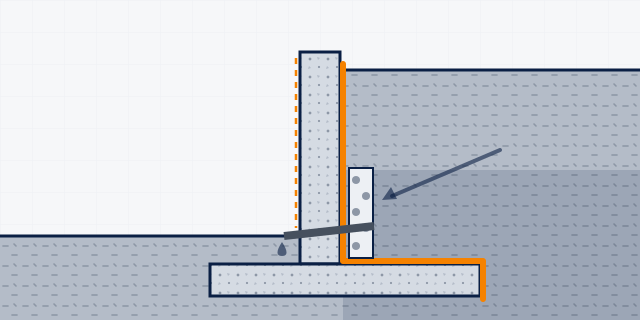
Retaining wall section with a coating on the soil side, a gravel drain and a weep pipe through the wall.

Get this solution priced Proposal brief ↓

You need this when…

  • Wet patches, salts or algae on the exposed face
  • Water seeping through construction or expansion joints
  • Rust stains or spalling on the exposed face
  • Water building up behind the wall after rain
  • Leaks at pipe or drain penetrations

The work, step by step

General guidance based on the manufacturer data sheets. Site conditions differ: confirm the system with MCT before you start. Where we do not name a product, ask us and we will confirm the right one.

  1. Step 1: Engineer's check and drainage

    A retaining wall is a structure. Get the engineer to confirm stability and the drainage behind the wall, such as weep holes and drains, before waterproofing. Bulging, tilting or wide cracks need an engineer's assessment.

  2. Step 2: Watertight concrete (new walls)

    Add a crystalline admixture, which lists retaining walls (SikaControl-760 p.1, p.2), or a liquid waterproofing admixture (Sika-1 PK p.1).

    Other options for this stepAsk us

    The right product here depends on your site. We confirm it before naming it.

  3. Step 3: Joints in the wall (new walls)

    Use a waterbar at construction joints (Sika Waterbar V-20 L SH p.1) and at expansion joints (Sika Waterbar O-20 SH p.1). A swelling sealant can be used at construction joints only (SikaSwell S-2 p.1, p.2).

    Other options for this stepAsk us

    The right product here depends on your site. We confirm it before naming it.

  4. Step 4: Coat the soil face before backfilling

    Protect the face that will be against soil with a bituminous coating in 2–3 coats (Sika Bitumen p.1, p.2), a rubberised bitumen emulsion (Sika Igasol Emulsion BA-10 p.1), or a cement-based slurry (SikaTop-107 Seal PK p.1).

    Sika Igasol Emulsion BA-10 Sika Request a quotation

    Sika® Igasol® Emulsion BA-10 is used for: Tanking and waterproofing of substructures to provide an impervious membrane, Vapour barrier of cladded walls, Maintenance of many roof types including asphaltfelt roofs, concrete, cement, lightweight screeds, timber etc, As an adhesive for bonding insula… (TDS p.1)

    Temperature stated in TDS
    -10 °C min. / +85 °C max (TDS p.2)
  5. Step 5: Treat leaks on existing walls

    Plug running leaks in static cracks (SikaSet Waterplug p.1), then coat the exposed face with a slurry that works against negative pressure (SikaSeal-105 PK p.1).

    SikaSet Waterplug Sika Request a quotation

    Non-moving (static) cracks and holes with running water or moisture seepage For immersion service For anchoring vertical bolts Basements Foundations Retaining walls Sewers Locations Vertical, overhead, or horizontal Interior or exterior Above or below grade… (TDS p.1)

  6. Step 6: Seal expansion joints

    Clean the joint, insert a backer rod, prime with Sika Primer PS, and seal with a polysulphide sealant that lists retaining walls. Joint movement must not exceed ±25 % at a 2:1 width-to-depth ratio (Sika Polysulphide GG p.1, p.2, p.3; Sika Primer PS p.1).

  7. Step 7: Protect the exposed face

    A clear water-repellent impregnation reduces water and chloride uptake on the visible face (Sikagard-700 S PK p.1).

Proposal brief

Retaining walls: scope and system

A starting point for a site proposal. Quantities, prices and the final specification follow a site visit or photos.

Scope of work

  1. Inspection and photo record of the wall
  2. Joint waterproofing (new walls) or leak plugging (existing walls)
  3. Soil-face coating on x m² before backfilling
  4. Expansion-joint sealing (x m)
  5. Water-repellent treatment of the exposed face

System build-up

StepProductPackSource
2. Watertight concrete (new walls)SikaControl-760SikaControl®-760 is available in 5 Kg & 25 kg pack.TDS p.1 · March 2025, Version 04.01
3. Joints in the wall (new walls)SikaSwell S-2600 ml unipacsTDS p.1 · May 2021, Version 02.01
4. Coat the soil face before backfillingSika Bitumen14 Kg pailsTDS p.1 · May 2021, Version 01.01
4. Coat the soil face before backfillingSika Igasol Emulsion BA-10—TDS p.1 · May 2021, Version 01.01
4. Coat the soil face before backfillingSikaTop-107 Seal PK—TDS p.1 · May 2026, Version 03.02
5. Treat leaks on existing wallsSikaSet Waterplug—TDS p.1 · September 2024, Version 02.01
5. Treat leaks on existing wallsSikaSeal-105 PK—TDS p.1 · February 2026, Version 02.01
6. Seal expansion jointsSika Primer PS—TDS p.1 · March 2026, Version 01.01
6. Seal expansion jointsSika Polysulphide GG—TDS p.1 · May 2021, Version 02.01
7. Protect the exposed faceSikagard-700 S PK1000 ltr IBCTDS p.1,2 · August 2026, Version 01.01

What we need from you

  • Wall length and height, and whether it is new or existing
  • Photos of both faces, joints and any leaks
  • Drainage behind the wall (weep holes, gravel, pipes)
  • Engineer's drawings, if any

Site conditions

  • Soil face accessible before backfilling, for coating
  • Dry surfaces free of standing water (Sika Bitumen p.2)
  • Engineer's sign-off on stability

Not included

  • Structural design, strengthening or rebuilding
  • Excavation, backfill and drainage works
  • Landscaping

Questions customers ask

Our wall leaks but we cannot dig behind it. What can be done?

Plug running leaks (SikaSet Waterplug p.1), then coat the exposed face with a slurry rated for negative water pressure (SikaSeal-105 PK p.1). Drainage behind the wall must also work: ask us.

How much can the joint sealant move?

Sika Polysulphide GG takes ±25 % of the joint width when installed at a 2:1 width-to-depth ratio (Sika Polysulphide GG p.2).

Is the bitumen coating safe against salty soil?

Sika Bitumen is made to protect concrete against aggressive soils and has high resistance to aggressive chemicals and salts (Sika Bitumen p.1).

Steps and product facts are taken from the manufacturer data sheets (page cited). Products are named only where the data sheet confirms the use; quantities follow a site visit or photos. General guidance: check the data sheet or ask us before you start.