It is used on porous substrates such as concrete, brick work and timber. (TDS p.1)
- Temperature stated in TDS
- +5 °C min. / +40 °C max (TDS p.1)


Popular: Sikaflex · waterproofing · grout · data sheets
The gaps between building blocks, slabs, walls and roofs that let the structure expand, shrink and settle. They need a sealant or tape matched to the movement, a correctly sized joint and a backer rod, or water gets in and edges break.
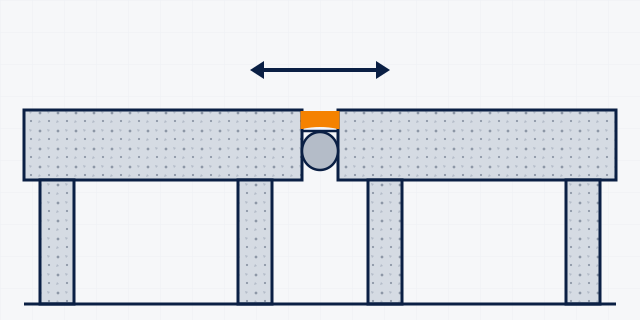
General guidance based on the manufacturer data sheets. Site conditions differ: confirm the system with MCT before you start. Where we do not name a product, ask us and we will confirm the right one.
The joint width must suit the movement and the sealant. All joints must be designed to the relevant standards. For Sikaflex Construction AP, joints are 10–40 mm wide with a 2:1 width-to-depth ratio. For example, joints at 6 m spacing need at least 20 mm width and 10 mm depth (Sikaflex Construction AP p.2).
Joint faces must be clean, dry and sound. Cut back weak edges and fill them with repair mortar. Press a closed-cell polyethylene backer rod tightly into the joint to set the depth, and use bond-breaker tape over the backer. Mask the edges (Sika Polysulphide GG p.3).
Sika Primer PS is the primer for Sika Polysulphide GG on porous substrates such as concrete, brickwork and timber (Sika Primer PS p.1; Sika Polysulphide GG p.3). Brush it on the two joint sides only; wait at least 30 minutes and no more than 3 hours (Sika Polysulphide GG p.3). For Sikaflex sealants, use the primer named in that sealant's own data sheet; ask us, as that primer's data sheet is not on file.
It is used on porous substrates such as concrete, brick work and timber. (TDS p.1)
Sika Polysulphide GG is a two-part sealant for vertical and horizontal expansion joints in high- and low-rise buildings, retaining walls, reservoirs and bridges (Sika Polysulphide GG p.1). Movement up to ±25 % at a 2:1 width-to-depth ratio, for joints 6–50 mm wide (Sika Polysulphide GG p.2).
It is used in both vertical and horizontal expansion joints in many types of buildings and civil engineering constructions such as: Retaining walls, Underpasses and tunnels, Reservoirs, Precast concrete elements, Bridges, High and low rise buildings and. (TDS p.1)
Sikaflex Construction AP is a one-part elastic sealant for movement and connection joints on porous substrates, indoors and outdoors, with ±25 % movement (Sikaflex Construction AP p.1). Sikaflex AT Facade is a low-modulus option, for joints up to 50 mm wide (Sikaflex AT Facade p.1, p.2).
Sikaflex® Construction AP is designed for movement and connection joints on porous substrates as well as indoor and outdoor general sealing applications. (TDS p.1)
Sikaflex® AT Facade is designed for joint sealing of movement and connection joints, porous and nonporous substrates such as concrete, brick, steel metals. (TDS p.1)
Sikadur-Combiflex SG-20 P is a bonded tape for movement joints, cracks and building parts where settlement is expected, in basements and water-retaining structures (Sikadur-Combiflex SG-20 P p.1). For higher movement, loop the tape into the joint. Bond it with Sikadur-31 DW (Sikadur-Combiflex SG-20 P p.3), which is for experienced professionals only (Sikadur-31 DW p.1).
Sikadur-Combiflex® SG-20 P is used for sealing: Movement joints, Construction joints, Pipe penetrations, Cracks, Building components where differential settlement is expected Sikadur-Combiflex® SG-20 P is used for the following areas:, Tunnels. (TDS p.1)
Structural adhesive for bonding: Concrete elements, Hard natural stone, Ceramics, fibre cement, Mortar, Bricks, Masonry, Steel, Iron, Aluminium, Wood. (TDS p.1)
Tool the sealant firmly against the joint sides (Sikaflex Construction AP p.3). Polysulphide must be fully cured before it is kept under water (Sika Polysulphide GG p.2).
A starting point for a site proposal. Quantities, prices and the final specification follow a site visit or photos.
| Step | Product | Pack | Source |
|---|---|---|---|
| 3. Prime porous joint faces | Sika Primer PS | — | TDS p.1 · March 2026, Version 01.01 |
| 4. Structural joints in walls, roofs and retaining walls | Sika Polysulphide GG | — | TDS p.1 · May 2021, Version 02.01 |
| 5. General building joints on porous substrates | Sikaflex Construction AP | — | TDS p.1 · May 2021, Version 01.01 |
| 5. General building joints on porous substrates | Sikaflex AT Facade | — | TDS p.1 · May 2021, Version 02.01 |
| 6. Wide or uneven movement, and below-ground joints | Sikadur-Combiflex SG-20 P | — | TDS p.1 · May 2025, Version 04.01 |
| 6. Wide or uneven movement, and below-ground joints | Sikadur-31 DW (professionals) | — | TDS p.1 · May 2021, Version 03.01 |
It depends on the design movement. As a guide for Sikaflex Construction AP, joints at 6 m spacing need at least 20 mm width and 10 mm depth, at a 2:1 width-to-depth ratio (Sikaflex Construction AP p.2).
A closed-cell polyethylene backer rod to set the depth, with bond-breaker tape over it (Sika Polysulphide GG p.3; Sikaflex Construction AP p.2).
Not in drinking-water tanks. The data sheet says do not use it in contact with drinking water or food (Sika Polysulphide GG p.2). See the water tank guide.
Sikaflex Construction AP can be over-painted with most facade paints after a compatibility test (Sikaflex Construction AP p.2). For polysulphide, check paint compatibility first (Sika Polysulphide GG p.2).
No. SikaSwell S-2 is not for movement joints (SikaSwell S-2 p.2).
Steps and product facts are taken from the manufacturer data sheets (page cited). Products are named only where the data sheet confirms the use; quantities follow a site visit or photos. General guidance: check the data sheet or ask us before you start.