

Skip to content
Step-by-step solution

Chemical-resistant tile grout and bedding

Tiled floors and walls in food plants, dairies, labs, industrial kitchens, plant rooms and thermal or salt-water pools need epoxy bedding and grout that resist acids, cleaning agents and wash-down. These are specialist systems.

  • 6 steps
  • 6 products
  • 4 answers
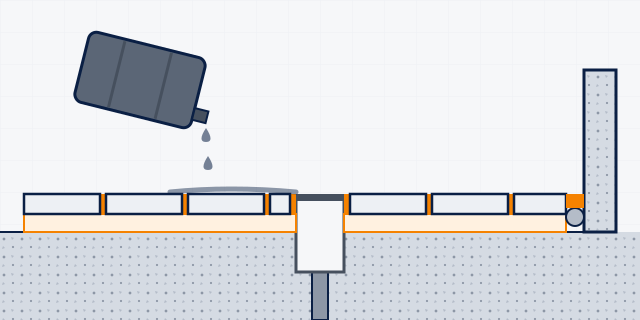
Factory floor tiles on orange epoxy bed and grout, a drain in the floor, and liquid dripping from a tipped drum

Get this solution priced Proposal brief ↓

You need this when…

  • Grout eaten away in a dairy, bakery or meat-processing floor
  • Acid spills etching lab or battery-room tile joints
  • Tiles lifting where hot wash-down water collects
  • Joint failure in a thermal or salt-water pool

The work, step by step

General guidance based on the manufacturer data sheets. Site conditions differ: confirm the system with MCT before you start. Where we do not name a product, ask us and we will confirm the right one.

  1. Step 1: List the exposure

    Record the chemicals, concentrations, temperatures and cleaning methods. Sikadur-54 Ceramic gives an immersion resistance list, for example 5 % acetic acid, 10 % lactic acid, whey and sea water (Sikadur-54 Ceramic p.2). SikaCeram RSG 705 takes dry heat up to +50 °C, but not chemical and mechanical exposure at the same time. Ask us for its full chemical table (SikaCeram RSG 705 p.2).

  2. Step 2: Prepare a dry, sound base

    Remove laitance, oil, grease and old coatings by wire brushing or grit blasting. The base must be dry, with no more than 4 % moisture and no rising moisture. Repair cracks and honeycombing first (SikaCeram RSG 705 p.2, p.3).

  3. Step 3: Bed and grout with one epoxy

    SikaCeram RSG 705 beds and grouts tiles with the same material, for food production, industrial kitchens, substations, laboratories, pools and breweries (SikaCeram RSG 705 p.1). Mix only full sets, and add no fillers or solvents. Stop work if the temperature may fall below 10 °C. Above 30 °C, working time can drop by up to 50 % (SikaCeram RSG 705 p.3). Clean off excess within 15 minutes (SikaCeram RSG 705 p.4).

    SikaCeram RSG 705 Sika Request a quotation

    SikaCeram® RSG 705 is used wherever a high degree of chemical resistance and excellent mechanical properties are required, such as: Food production: meat, fish, vegetable and fruit processing, canning areas, dairies and bakeries, Industrial kitchens and catering facilities, Electrical substations… (TDS p.1)

    Temperature stated in TDS
    +10°C min. / +35°C max (TDS p.2)
  4. Step 4: Or grout with Sikadur-54 Ceramic (professionals only)

    For experienced professionals only (Sikadur-54 Ceramic p.1). Fills 5–20 mm joints in laboratories, food and beverage plants, medical rooms, thermal, mineral or salt-water pools, storage tanks and sewage plants (Sikadur-54 Ceramic p.1, p.2). Joints must be dry and free of adhesive (Sikadur-54 Ceramic p.3). Remove surplus with warm water after 30–60 minutes (Sikadur-54 Ceramic p.4). Homeowners: please use an applicator.

  5. Step 5: Lighter duty: kitchens, hospitals, food areas

    SikaCeram-850 Design lists commercial and industrial kitchens, hospitals and the food industry, with good chemical resistance (SikaCeram-850 Design p.1). Ask us for details of specific chemicals (SikaCeram-850 Design p.2).

  6. Step 6: Seal the movement joints

    Rigid epoxy grout must not be used in joints that move (Sikadur-54 Ceramic p.3). Seal movement joints with Sikaflex PRO-3, which is listed for the food industry and sewage plants (Sikaflex PRO-3 p.1), or Sikaflex PRO-3 WF, which has an ISEGA food-area certificate (Sikaflex PRO-3 WF p.1). For fuel stations and containment bunds, Sikaflex Tank N is for professional applicators only (Sikaflex Tank N p.1).

    Sikaflex PRO-3 WF Sika Request a quotation

    Sikaflex® PRO-3 WF is designed for movement and connection joints in floors, pedestrian and traffic areas (e.g. (TDS p.1)

    Temperature stated in TDS
    40 °C min. / +70 °C max (TDS p.2)
Proposal brief

Chemical-resistant tile grout and bedding: scope and system

A starting point for a site proposal. Quantities, prices and the final specification follow a site visit or photos.

Scope of work

  1. Exposure review (chemicals, temperatures, cleaning)
  2. Substrate preparation and repair of x m²
  3. Epoxy bedding and grouting of acid-resistant or ceramic tiles
  4. Sealing of movement joints with a chemical-resistant sealant

System build-up

StepProductPackSource
3. Bed and grout with one epoxySikaCeram RSG 705—TDS p.1 · September 2024, Version 02.01
4. Or grout with Sikadur-54 Ceramic (professionals only)Sikadur-54 Ceramic (professionals)—TDS p.1 · May 2021, Version 01.01
5. Lighter duty: kitchens, hospitals, food areasSikaCeram-850 Design400 ml double side-by-side cartridgeTDS p.1 · April 2025, Version 01.01
6. Seal the movement jointsSikaflex PRO-3600 ml cylindrical foil packTDS p.1 · May 2021, Version 03.01
6. Seal the movement jointsSikaflex PRO-3 WF—TDS p.1 · May 2021, Version 02.01
6. Seal the movement jointsSikaflex Tank N (professionals)—TDS p.1 · September 2023, Version 01.02

What we need from you

  • List of chemicals with concentrations and temperatures
  • Cleaning method (steam, hot water jet, acid or alkaline detergents)
  • Area (m²), tile type, and photos of the current floor
  • Allowed shutdown time for the area
  • Traffic: trolleys, forklifts, pallet trucks?

Site conditions

  • Base dry, below 4 % moisture, no rising moisture (SikaCeram RSG 705 p.2)
  • Ambient temperature +10 °C to +35 °C during application (SikaCeram RSG 705 p.2)
  • Application by an experienced professional team (Sikadur-54 Ceramic p.1)

Not included

  • Concrete repairs and screed works are quoted separately after inspection
  • Drainage or gully replacement
  • Chemicals not listed by the client

Questions customers ask

Which grout for a salt-water or thermal pool?

Sikadur-54 Ceramic lists swimming pools with thermal, mineral or salt water (Sikadur-54 Ceramic p.1). SikaCeram RSG 705 lists swimming pools (SikaCeram RSG 705 p.1). Sealants such as Sikaflex PRO-3 must not be used around pools (Sikaflex PRO-3 p.3).

Will it handle daily acid wash-down in a dairy?

Sikadur-54 Ceramic resisted 10 % lactic acid, 10 % citric acid and whey in 4-week immersion tests. Discolouration and slight softening are possible (Sikadur-54 Ceramic p.2). For your exact chemicals, ask us.

Can it take steam cleaning?

Sikadur-54 Ceramic lists steam and water-jet cleaning facilities (Sikadur-54 Ceramic p.1). SikaCeram RSG 705 takes dry heat up to +50 °C (SikaCeram RSG 705 p.2). For steam on SikaCeram RSG 705, ask us.

Can our own staff apply it?

Sikadur-54 Ceramic is for experienced professionals only (Sikadur-54 Ceramic p.1). We recommend a trained applicator for these systems.

Steps and product facts are taken from the manufacturer data sheets (page cited). Products are named only where the data sheet confirms the use; quantities follow a site visit or photos. General guidance: check the data sheet or ask us before you start.