Sikaflex®-400 Fire is designed for fire rated movement and connection joints and penetrations on porous and non-porous substrates. (TDS p.1)
- Temperature stated in TDS
- +5 °C to +40 °C (TDS p.2)


Popular: Sikaflex · waterproofing · grout · data sheets
Joints in fire-rated walls and floors, such as stair and lift shafts, compartment walls and plant rooms, must hold back fire and smoke for the rated time. The rating comes from a tested configuration, not from the sealant alone.
General guidance based on the manufacturer data sheets. Site conditions differ: confirm the system with MCT before you start. Where we do not name a product, ask us and we will confirm the right one.
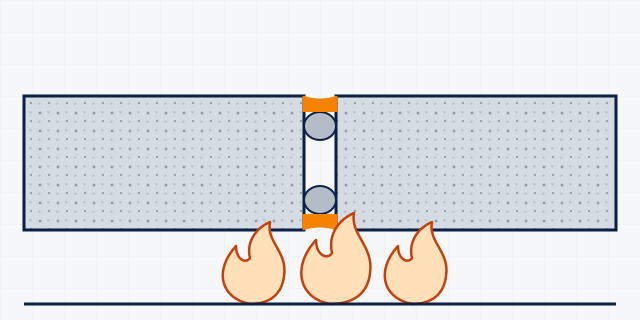
Agree the required fire-resistance time with the fire consultant. Design the joint from the test certificates (Sika Firerate p.2). For Sikaflex-400 Fire, joint design and backing material follow the approvals and the Sika Passive Fire Protection Handbook (Sikaflex-400 Fire p.2).
The substrate must be sound, clean and dry. Repair damaged edges with Sika repair products, and saw-cut new joints (Sikaflex-400 Fire p.3). Do not apply Sika Firerate to damp or wet surfaces (Sika Firerate p.2).
Sikaflex-400 Fire is a polyurethane fire-rated sealant for movement and connection joints and penetrations, with up to 4 hours of fire resistance (AS 1530.4, EN 1366-4) and ±35 % movement, for internal and external use (Sikaflex-400 Fire p.1). Prime porous substrates with Sika Primer-3 N or Primer-210 (Sikaflex-400 Fire p.3). Sikasil-670 Fire is a silicone with up to 4 hours (EN 1366-4), for joints 10–40 mm wide and up to 20 mm deep, at 2:1, over polyethylene foam backing rods (Sikasil-670 Fire p.1, p.2).
Sikaflex®-400 Fire is designed for fire rated movement and connection joints and penetrations on porous and non-porous substrates. (TDS p.1)
Sikasil®-670 Fire is designed for fire rated movement and connection joints on porous and non-porous substrates. (TDS p.1)
Sika Firerate is an intumescent acrylic for interior fire-rated joints, with up to 4 hours (AS 1530.4) and ±20 % movement (Sika Firerate p.1). Joints are 10–50 mm wide and no more than 10 mm deep, at 2:1, over polyethylene foam backing rods (Sika Firerate p.1, p.2).
Sika® Firerate is designed for fire rated movement and connection joints on porous and non-porous substrates. (TDS p.1)
A flame-retardant sealant is not a fire-rated joint. Where your fire consultant accepts a flame-retardant (not rated) seal, ask us. For any rated joint, use only a product with fire-resistance test evidence for that joint width and wall or floor type.
The right product here depends on your site. We confirm it before naming it.
Keep the data sheets and classification reports with the handover file. The dimension and configuration limits in those reports must be met (SikaSeal-623 Fire p.2).
A starting point for a site proposal. Quantities, prices and the final specification follow a site visit or photos.
| Step | Product | Pack | Source |
|---|---|---|---|
| 3. Movement joints, inside and outside | Sikaflex-400 Fire | — | TDS p.1 · April 2021, Version 02.01 |
| 3. Movement joints, inside and outside | Sikasil-670 Fire | — | TDS p.1 · December 2022, Version 04.02 |
| 4. Interior joints in walls and partitions | Sika Firerate | — | TDS p.1 · May 2021, Version 01.01 |
Up to 4 hours in tested configurations: Sikaflex-400 Fire (AS 1530.4, EN 1366-4), Sikasil-670 Fire (EN 1366-4) and Sika Firerate (AS 1530.4) (each data sheet p.1). The actual rating depends on joint size and build-up (Sika Firerate p.2).
No. Use a product with fire-resistance test evidence. Sika Firesil-N is flame-retardant, but its data sheet gives no fire-resistance time (Sika Firesil-N p.1, p.2). Ask us for the rated options.
Sikaflex-400 Fire can be over-painted after a compatibility trial (Sikaflex-400 Fire p.2). Sikasil-670 Fire cannot be over-painted (Sikasil-670 Fire p.3).
Sikaflex-400 Fire is for internal and external use (Sikaflex-400 Fire p.1). Sika Firerate is for interior use (Sika Firerate p.1).
Steps and product facts are taken from the manufacturer data sheets (page cited). Products are named only where the data sheet confirms the use; quantities follow a site visit or photos. General guidance: check the data sheet or ask us before you start.