

Skip to content
Step-by-step solution

Floor tiling (homes, shops and outdoor floors)

Fixing ceramic, porcelain and stone floor tiles indoors, on courtyards and terraces, on heated floors and in shops with heavy foot traffic. A flat, mature base and the right adhesive stop hollow, cracking and lifting tiles.

  • 7 steps
  • 9 products
  • 5 answers
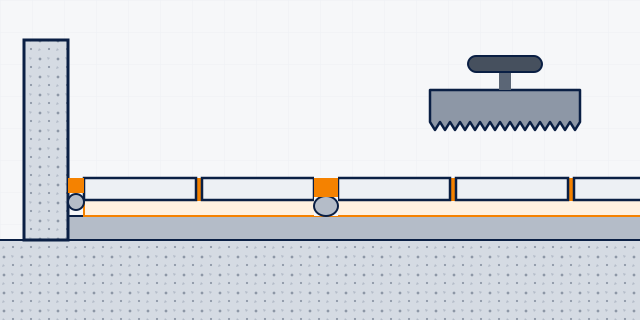
Floor tiles on an orange adhesive bed over screed and slab, with sealed movement joints and a notched trowel above

Get this solution priced Proposal brief ↓

How the system works

The problem, and the system that solves it

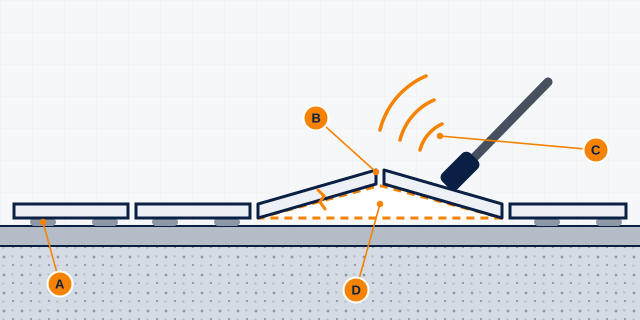
Open the diagram full sizeWhy floor tiles come loose: Tiles laid on dabs of adhesive leave hollow spaces under them. With no movement joints, the floor's expansion pushes tiles up into a 'tent'. Hollow tiles sound dull when tapped and crack under load. The void under the tile means it is held only at a few points.
Problem Why floor tiles come loose
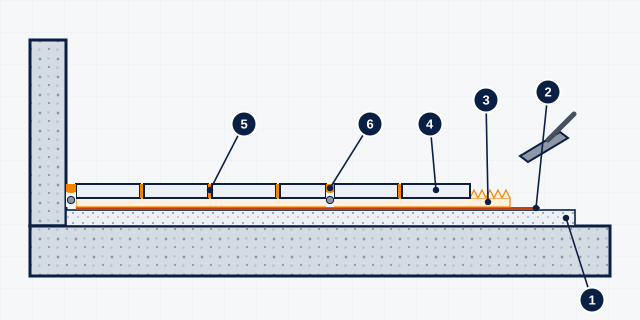
Open the diagram full sizeSystem build-up, numbered in application order: 1 Level, sound base; 2 Waterproofing (wet floors only); 3 Adhesive with full bed; 4 Tiles; 5 Grout; 6 Perimeter and movement joints
Solution The system, layer by layer, in application order

What goes wrong

  1. A: Tiles laid on dabs of adhesive leave hollow spaces under them.
  2. B: With no movement joints, the floor's expansion pushes tiles up into a 'tent'.
  3. C: Hollow tiles sound dull when tapped and crack under load.
  4. D: The void under the tile means it is held only at a few points.

How the system works

A level base, the right adhesive for the use and full contact under every tile carry the load evenly. C2TE on an adhesive means cementitious (C), improved strength (2), reduced slip (T) and extended open time (E). Movement joints at the edges and across large floors let the floor expand without lifting the tiles.

The system, layer by layer

  1. Layer 1: Level, sound base

    What it does: A screed or levelling mortar, improved with a latex where needed.

    Why it is needed here: Tile adhesives need a flat base: the adhesive data sheet asks for levelling where the base is out by 5 mm or more under a 2 m straightedge.

    • SikaLatex PK TDS: admixture for site-mix grouts and screeds (SikaLatex PK p.1); the adhesive TDS says level bases over 5 mm out under 2 m with a mortar made with Sika Latex (SikaCeram-205 PK p.3).
  2. Layer 2: Waterproofing (wet floors only)

    What it does: A membrane under the tiles in wet areas.

    Why it is needed here: Tiles and grout are not waterproof; wet floors need the membrane first.

  3. Layer 3: Adhesive with full bed

    What it does: Notched-trowel ribs pressed flat so the adhesive fully covers the tile back.

    Why it is needed here: Full contact removes the hollow spots that cause loose and cracked tiles. Choose the adhesive by tile and use: indoor ceramic and marble, or C2TE for outdoor, heavy-traffic and heated floors.

    • SikaCeram-90 PK TDS: fixes wall and floor tiles, marble and terrazzo tiles; suitable for indoor and outdoor application (p.1).
    • SikaCeram-103 PK TDS: ceramic, porcelain and marble, indoors on walls or floors, on cement-based substrates; layers up to 10 mm (p.1).
    • SikaCeram-51 TDS: high-absorption ceramic tiles, indoors, floor and wall, over concrete, cement mortars and bricks (p.1).
    • SikaCeram-205 PK TDS: indoor walls and floors, outdoor floors, water-based heating floors, swimming pools, industrial and heavy-traffic floors (p.1).
  4. Layer 4: Tiles

    What it does: The wearing finish.

    Why it is needed here: Protect new tiles from traffic until the adhesive has set.

  5. Layer 5: Grout

    What it does: Fills the joints between tiles.

    Why it is needed here: Cement grout for general floors; epoxy grout for interior wet rooms and commercial kitchens.

    • SikaCeram-600 Tile Grout PK TDS: cement grout for floor and wall, interior and exterior, dry and wet areas (p.1); foot traffic after 24 hours (p.2).
    • SikaCeram-850 Design TDS: epoxy floor/wall grout for interior wet rooms, shopping malls, hospitals and commercial kitchens (p.1).
  6. Layer 6: Perimeter and movement joints

    What it does: A gap at walls and across large floors, filled with an elastic sealant over a backer rod.

    Why it is needed here: Floors expand and shrink; the joints absorb the movement so tiles do not lift.

    • Sikaflex PRO-3 TDS: PU sealant for floor joints, pedestrian and traffic areas, interior and exterior (p.1); EN 15651-4 PW EXT-INT (p.1); joint width 10-40 mm, width:depth 1:0.8 (p.2).

Common mistakes to avoid

  • Tiling on a base younger than 28 days or out of level by 5 mm under 2 m without levelling first (SikaCeram-205 PK p.2, p.3).
  • Using SikaCeram-51 or SikaCeram-103 PK outdoors (SikaCeram-51 p.2; SikaCeram-103 PK p.1), or SikaCeram-90 PK directly on gypsum (p.2).
  • Using SikaCeram-850 Design on exterior floors: interior only (p.1).
  • Sealing natural stone without a plasticiser-migration trial (Sikaflex PRO-3 p.3).

Products are named only where the data sheet confirms the use (verified); other layers say "Ask us". Diagrams are schematic, not to scale. Draft pending technical sign-off.

You need this when…

  • Floor tiles sound hollow or rock underfoot
  • Tiles cracking along a line or lifting in summer heat
  • Grout crumbling out of the joints
  • Courtyard or terrace tiles coming loose after the monsoon
  • New screed or slab ready for tiling

The work, step by step

General guidance based on the manufacturer data sheets. Site conditions differ: confirm the system with MCT before you start. Where we do not name a product, ask us and we will confirm the right one.

  1. Step 1: Check and level the base

    Remove weak concrete and laitance. Cement bases must be at least 28 days old (SikaCeram-205 PK p.2). Level differences must be less than 5 mm under a 2 m straightedge. If they are more, level the base first with a mortar made with Sika Latex, MonoTop or SikaRep (SikaCeram-205 PK p.3). Allow 24–48 hours after repairs before tiling (SikaCeram-205 PK p.2).

  2. Step 2: Waterproof wet floors first

    For bathrooms, kitchens and wash areas, apply a waterproof coating listed for wet areas under tiling (SikaTop-550 Seal p.1). For roofs and terraces, follow the waterproofing guides before tiling.

  3. Step 3: Indoor floors: ceramic and marble

    SikaCeram-90 PK fixes floor tiles, marble and terrazzo, and is suitable indoors and outdoors (SikaCeram-90 PK p.1). SikaCeram-103 PK fixes ceramic, porcelain and marble on indoor floors, in layers up to 10 mm (SikaCeram-103 PK p.1). SikaCeram-51 is for high-absorption ceramic tiles indoors only (SikaCeram-51 p.1, p.2).

    SikaCeram-103 PK Sika Request a quotation

    SikaCeram®-103 PK is suitable for bonding all kinds of ceramic tiles, porceline tile and marbel stones. (TDS p.1)

    Temperature stated in TDS
    +5 °C min. / +35 °C max (TDS p.2)
    Pack
    20 kg
    SikaCeram-51 Sika Request a quotation

    Suitable for bonding high absorption ceramic tiles Indoor application without primer over concrete, cement mortars, bricks Suitable for floor and wall applications (TDS p.1)

    Temperature stated in TDS
    +5 °C min. / +35 °C max (TDS p.2)
    Pack
    Grey color - 25 kg bag
  4. Step 4: Outdoor floors, heavy traffic and heated floors

    SikaCeram-205 PK is listed for outdoor floors, swimming pools, industrial and heavy-traffic floors, and water-based heating floors (SikaCeram-205 PK p.1).

  5. Step 5: Bed the tiles fully

    Choose the notched trowel by tile size: 6 mm for small tiles, 8 mm for 20 × 20 to 40 × 40 cm, 10 mm for large tiles (SikaCeram-205 PK p.2). Back-butter tiles larger than 300 × 300 mm or tiles that will carry heavy loads, and press each tile firmly into the adhesive (SikaCeram-205 PK p.3).

  6. Step 6: Protect, then grout

    Keep foot traffic off for at least 24 hours, and grout no sooner than 24 hours (SikaCeram-205 PK p.3). Cement grout covers floors, inside and outside, dry and wet areas (SikaCeram-600 Tile Grout PK p.1). Wait 24 hours before walking on new grout (SikaCeram-600 Tile Grout PK p.2). Use epoxy grout in wet rooms, malls and commercial kitchens (SikaCeram-850 Design p.1).

    SikaCeram-600 Tile Grout PK Sika Request a quotation

    For filling the spaces of homogeneous tile, ceramic tile, marble, granite, mosaic, and natural stone, over a range of applications as below: Floor and wall, Interior and exterior, Dry and wet area, For dry area, mix SikaCeram®-600 Tile Grout PK with water, Do not mix the fresh material to previou… (TDS p.1,2)

    Temperature stated in TDS
    15 °C to 40 °C (TDS p.2)
    Pack
    1 kg Pouch
  7. Step 7: Seal perimeter and movement joints

    Leave movement joints in normal practice (SikaCeram RSG 705 p.3), and seal them with a floor sealant for pedestrian areas (Sikaflex PRO-3 p.1). Insert a closed-cell polyethylene backer rod (Sikaflex PRO-3 p.3). Joints must be 10–40 mm wide with a width-to-depth ratio of 1:0.8 (Sikaflex PRO-3 p.2).

Proposal brief

Floor tiling (homes, shops and outdoor floors): scope and system

A starting point for a site proposal. Quantities, prices and the final specification follow a site visit or photos.

Scope of work

  1. Inspection and levelling of x m² of floor base
  2. Waterproofing of wet floors before tiling
  3. Tile fixing with an adhesive matched to tile size, base and indoor/outdoor use
  4. Grouting, and sealing of perimeter and movement joints

System build-up

StepProductPackSource
1. Check and level the baseSikaLatex PK05 ltr jerry can 20 ltr plastic can 200 ltr drum 1000 ltr IBC Bulk supply in tanker is…TDS p.1 · June 2025, Version 02.01
2. Waterproof wet floors firstSikaTop-550 Seal—TDS p.1 · March 2024, Version 01.01
3. Indoor floors: ceramic and marbleSikaCeram-90 PK20 kg & 40 kg bagTDS p.1 · October 2023, Version 01.02
3. Indoor floors: ceramic and marbleSikaCeram-103 PK20 kgTDS p.1 · June 2025, Version 06.01
3. Indoor floors: ceramic and marbleSikaCeram-51Grey color - 25 kg bagTDS p.1 · May 2021, Version 03.01
4. Outdoor floors, heavy traffic and heated floorsSikaCeram-205 PK—TDS p.1 · October 2023, Version 01.02
6. Protect, then groutSikaCeram-600 Tile Grout PK1 kg PouchTDS p.1,2 · June 2024, Version 01.01
6. Protect, then groutSikaCeram-850 Design400 ml double side-by-side cartridgeTDS p.1 · April 2025, Version 01.01
7. Seal perimeter and movement jointsSikaflex PRO-3600 ml cylindrical foil packTDS p.1 · May 2021, Version 03.01

What we need from you

  • Floor area (m² / sq ft), indoor or outdoor
  • Tile type and size
  • What is the base now: new screed, old concrete, or old tiles?
  • Underfloor heating, vehicles or heavy loads?
  • Photos of the floor

Site conditions

  • Base at least 28 days old (SikaCeram-205 PK p.2)
  • Base flat within 5 mm under a 2 m straightedge, or levelling quoted extra (SikaCeram-205 PK p.3)
  • No foot traffic for 24 hours after tiling and after grouting (SikaCeram-205 PK p.3; SikaCeram-600 Tile Grout PK p.2)

Not included

  • Screed laying or major levelling is quoted separately
  • Supply of client-selected tiles
  • Removal and disposal of old flooring, unless agreed

Questions customers ask

When can we walk on the new floor?

After at least 24 hours for light foot traffic (SikaCeram-205 PK p.3), and again 24 hours after grouting (SikaCeram-600 Tile Grout PK p.2).

Which adhesive for an outdoor courtyard?

SikaCeram-205 PK is listed for outdoor floors (SikaCeram-205 PK p.1), and SikaCeram-90 PK for indoor and outdoor use (SikaCeram-90 PK p.1). Do not use SikaCeram-51 outside (SikaCeram-51 p.2).

Can I tile over underfloor heating?

SikaCeram-205 PK lists laying on water-based heating floors (SikaCeram-205 PK p.1). For electric heating mats, ask us: it depends on site conditions.

The floor is not level. Can the adhesive fix that?

Only small irregularities. Differences of more than 5 mm under a 2 m straightedge must be levelled first with a Sika Latex, MonoTop or SikaRep mortar (SikaCeram-205 PK p.3).

We are tiling in June heat. What changes?

On very porous bases, or in high temperature or low humidity, dampen the base first, with no standing water (SikaCeram-205 PK p.3). Where the adhesive could dry fast, light water fogging for 48 hours after final set, hessian or a curing compound is recommended (SikaCeram-90 PK p.2).

Steps and product facts are taken from the manufacturer data sheets (page cited). Products are named only where the data sheet confirms the use; quantities follow a site visit or photos. General guidance: check the data sheet or ask us before you start.