Sanitary or other sealing applications where mildew and fungus resistance is required Domestic kitchens For interior and exterior use (TDS p.1)
- Temperature stated in TDS
- +5 °C min. / +40 °C max (TDS p.2)
- Pack
- 300 ml cartridge: 12 cartridges per box


Popular: Sikaflex · waterproofing · grout · data sheets
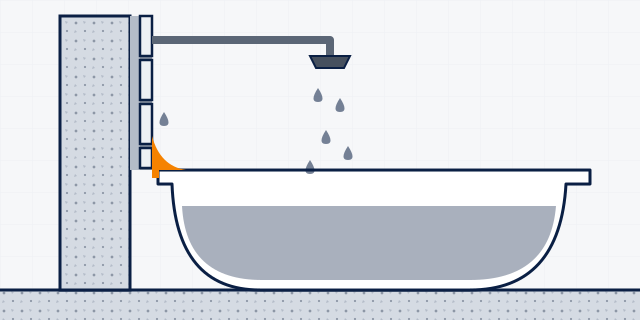
Silicone joints where tiles meet baths, shower trays, basins, WCs and kitchen worktops. Choose a mildew-resistant sealant that suits the surface, and reseal before water gets behind the tiles.
General guidance based on the manufacturer data sheets. Site conditions differ: confirm the system with MCT before you start. Where we do not name a product, ask us and we will confirm the right one.
The surface must be sound, clean and dry, free of dirt, oil, grease, old sealant and poorly bonded paint (Sika Sanisil p.3). Let the area dry fully before resealing.
Sika Sanisil is a mildew-resistant silicone for sanitary joints and domestic kitchens, with very good adhesion to non-porous surfaces (Sika Sanisil p.1). Do not use it on concrete, plaster, render or brick, or on porous stone, marble or granite (Sika Sanisil p.2). Sikasil-715 WS is a neutral-cure, antifungal silicone listed for wet-area joints in bathrooms, toilets and kitchens and around sanitaryware (Sikasil-715 WS p.1).
Sanitary or other sealing applications where mildew and fungus resistance is required Domestic kitchens For interior and exterior use (TDS p.1)
Sikasil®-715 WS is designed for weather proofing and sealing applications where durability under severe conditions is required. (TDS p.1)
For demanding joints, lightly roughen glazed tiles and aluminium, then pre-treat them with Sika Aktivator-205. Clean glass with isopropanol (Sika Sanisil p.3). Mask the edges for neat lines (Sika Sanisil p.3).
For joints 10–20 mm wide, a sealant depth of 10 mm is recommended. Use a closed-cell polyethylene backer rod (Sika Sanisil p.2).
Fill the joint in full contact with both sides, with no trapped air. Tool it firmly. Water can be used as a tooling aid, but not solvent products. Remove the masking within the skin time of about 25 minutes (Sika Sanisil p.2, p.3).
Sika Sanisil cures about 3 mm per 24 hours at +23 °C. It needs air moisture to cure, so it is not for fully confined spaces (Sika Sanisil p.2).
A starting point for a site proposal. Quantities, prices and the final specification follow a site visit or photos.
| Step | Product | Pack | Source |
|---|---|---|---|
| 2. Choose the sealant for the surface | Sika Sanisil | 300 ml cartridge: 12 cartridges per box | TDS p.1 · May 2021, Version 03.01 |
| 2. Choose the sealant for the surface | Sikasil-715 WS | 300 ml cartridge, 12 cartridges per box | TDS p.1 · May 2025, Version 03.01 |
Not with Sika Sanisil. The acetic acid released during curing can corrode mirror silver (Sika Sanisil p.2). Sikasil-715 WS is a neutral-cure silicone (Sikasil-715 WS p.1).
Sika Sanisil cures about 3 mm per 24 hours at +23 °C, so deeper joints need longer (Sika Sanisil p.2).
No. Sika Sanisil cannot be over-painted (Sika Sanisil p.2).
Sika Sanisil is not recommended on marble or granite, because staining may occur (Sika Sanisil p.2). Sikasil-715 WS lists natural stone after checking with Sika (Sikasil-715 WS p.1).
Mould grows on soap and moisture. Sika Sanisil has long-term fungus and mildew resistance (Sika Sanisil p.1), and Sikasil-715 WS is tested as antifungal (Sikasil-715 WS p.1). Reseal over clean, dry surfaces.
Steps and product facts are taken from the manufacturer data sheets (page cited). Products are named only where the data sheet confirms the use; quantities follow a site visit or photos. General guidance: check the data sheet or ask us before you start.