

The right product here depends on your site. We confirm it before naming it.
Step-by-step solution
Crane rail & runway grouting
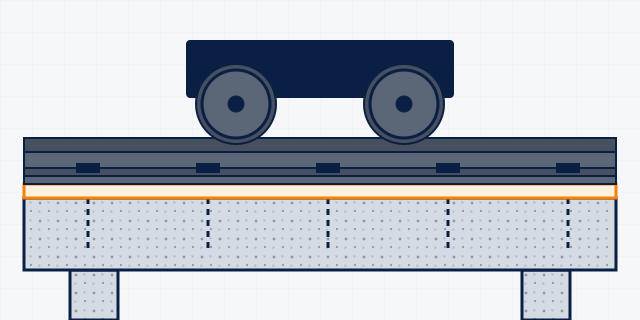
Overhead and gantry crane rails in workshops, steel mills and ports sit on grouted sole plates fixed with holding-down bolts. A high-strength, non-shrink grout with good fatigue and impact resistance keeps the rail level under repeated wheel loads.
- 6 steps
- 1 products
- 4 answers
You need this when…
- Crane rail rocking or clicking as the crane passes
- Cracked or broken grout under rail sole plates
- Loose holding-down bolts along the runway
- New crane runway to be installed on concrete
The work, step by step
General guidance based on the manufacturer data sheets. Site conditions differ: confirm the system with MCT before you start. Where we do not name a product, ask us and we will confirm the right one.
-
Step 1: Design and survey
The rail fixing system, bolt spacing and grout thickness are set by the crane supplier and the structural engineer. Survey the existing grout and bolts before quoting.
-
Step 2: Fix or replace holding-down bolts
For post-installed bolts in cracked or uncracked concrete use Sika AnchorFix-3001 or AnchorFix-3030 (p.1), with the hole cleaning set out in the TDS (Sika AnchorFix-3001 p.4).
Product for this stepAsk us -
Step 3: Prepare the concrete
Scrabble off laitance without crushing the aggregate, remove oil and curing compounds, soak for 24 hours and blow bolt holes free of water. Set and align the sole plates and lightly grease shims that will be removed (SikaGrout-951 p.2).
-
Step 4: Grout the sole plates
SikaGrout-951 lists crane rails among its uses, with good fatigue and impact resistance (p.1). Lay it 20–100 mm thick (p.2). Pour continuously with a head of at least 15 cm; metal strapping in the formwork helps the grout flow along long plates (p.2).
SikaGrout-951 Sika Request a quotation SikaGrout®-951 is formulated for use at any consistency from fluid to plastic, and may be used with confidence for bedding, grouting and precision bearing operations such as. (TDS p.1,2)
- Pack
- 25 kg
-
Step 5: Shallow plates and bearings
Where each pour is 10–50 mm deep, SikaGrout-275 PK is a precision grout for base plates and bearings (p.1, p.2).
Product for this stepAsk us The right product here depends on your site. We confirm it before naming it.
-
Step 6: Cure and keep the crane off
Immediately cover exposed grout with clean damp hessian and keep it moist until it can take a curing membrane (SikaGrout-951 p.2). Keep the runway free of excessive vibration until the grout has hardened (p.2).
Proposal brief
Crane rail & runway grouting: scope and system
A starting point for a site proposal. Quantities, prices and the final specification follow a site visit or photos.
Scope of work
- Survey of rail, sole plates, bolts and existing grout
- Removal of failed grout (where applicable)
- Holding-down bolt anchoring
- Surface preparation and formwork
- Supply and placing of high-strength grout, and curing
System build-up
| Step | Product | Pack | Source |
|---|---|---|---|
| 4. Grout the sole plates | SikaGrout-951 | 25 kg | TDS p.1,2 · June 2025, Version 04.01 |
What we need from you
- Runway length and number of sole plates
- Crane capacity and supplier's fixing details
- Grout gap under the plates
- Allowed crane shutdown period
- Photos of the current condition
Site conditions
- Crane and nearby vibration stopped until the grout hardens (SikaGrout-951 p.2)
- Rail alignment done by the crane contractor before grouting
Not included
- Rail alignment, clips and resilient pads
- Crane runway beam repairs
- Structural design
Questions customers ask
Can we grout without stopping the crane?
No. The area must be free of excessive vibration until the grout has hardened (SikaGrout-951 p.2).
How soon can the crane run again?
Ask us: it depends on site conditions and the design strength. SikaGrout-951 reaches ≥40 MPa at 1 day and ≥70 MPa at 7 days (p.1).
Can the grout be pumped along a long runway?
Yes. SikaGrout-951 is suitable for most types of pumping equipment (p.2).
Do you supply epoxy rail bedding or resilient rail pads?
Ask us: it depends on site conditions. These are not covered by the data sheets in this guide.
Steps and product facts are taken from the manufacturer data sheets (page cited). Products are named only where the data sheet confirms the use; quantities follow a site visit or photos. General guidance: check the data sheet or ask us before you start.