

The right product here depends on your site. We confirm it before naming it.
Step-by-step solution
Machine foundations & equipment bedding
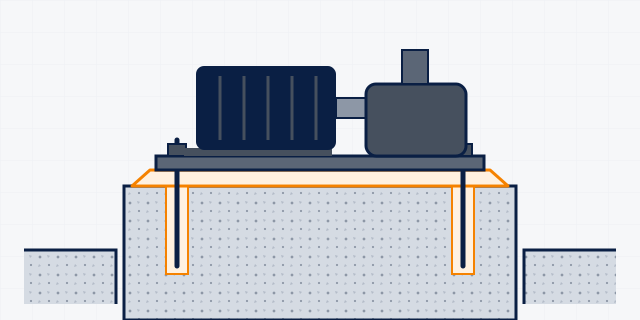
Generators, compressors, presses, pumps and turbines need a foundation that carries vibration and impact without loosening. The usual build-up is engineered concrete, anchored or grouted holding-down bolts, and a high-strength non-shrink bedding grout.
- 7 steps
- 3 products
- 4 answers
You need this when…
- New generator, chiller or press to be installed
- Machine bolts loosening and excess vibration
- Cracked or hollow grout under an existing machine
- Machine misalignment after months of running
The work, step by step
General guidance based on the manufacturer data sheets. Site conditions differ: confirm the system with MCT before you start. Where we do not name a product, ask us and we will confirm the right one.
-
Step 1: Start from the engineer's design
Foundation size, bolt type and grout thickness come from the machine supplier's and structural engineer's design. Machine foundations are a listed use of these grouts (SikaGrout-275 PK p.1; SikaGrout-114 PK p.1).
-
Step 2: Cast the foundation block
For large blocks, a retarding superplasticiser for mass pours reduces thermal peaks and keeps layers workable (Sikament RB 918 p.1); set the dosage by trial (p.2). Plastiretard spreads the heat release to reduce thermal stress (Sika Plastiretard TM 100 C2 WR PK p.1).
Product for this stepAsk us -
Step 3: Fix the holding-down bolts
For post-installed bolts use an epoxy anchor such as Sika AnchorFix-3001 or AnchorFix-3030, for cracked or uncracked, dry or damp concrete (p.1). Cast-in bolt pockets can be grouted with SikaGrout-114 PK, which is listed for concrete anchors and cavities (p.1).
SikaGrout-114 PK Sika SikaGrout®-114 PK is used for grouting in the following: Machine foundations, Columns in pre-cast construction, Concrete anchors, cavities, gaps, and recesses, Base plates, General concrete repairs, Bridge bearing pads. (TDS p.1)
Other options for this stepAsk us The right product here depends on your site. We confirm it before naming it.
-
Step 4: Prepare for bedding
Scrabble off laitance without using bush hammers, soak for 24 hours, keep bolt holes free of water and lightly grease shims that will be removed later (SikaGrout-951 p.2).
-
Step 5: Grout under the bedplate
SikaGrout-951 is formulated for turbines, generators, presses and milling machines, with good fatigue and impact resistance (p.1); lay it 20–100 mm thick (p.2). SikaGrout-275 PK is shrinkage compensated with moderate heat of hydration and high early strength (p.1).
SikaGrout-951 Sika Request a quotation SikaGrout®-951 is formulated for use at any consistency from fluid to plastic, and may be used with confidence for bedding, grouting and precision bearing operations such as. (TDS p.1,2)
- Pack
- 25 kg
SikaGrout-275 PK Sika SikaGrout®-275 PK precision grout is used for grouting various applications such as: Machine foundations, Coloumns in precast costruction, Concrete anchors, Cavities, gaps and recesses, Base plates, Bridge bearing. (TDS p.1)
- Temperature stated in TDS
- +5 °C min. / +35 °C max (TDS p.2)
-
Step 6: Keep it still while it hardens
The area must be free of excessive vibration: shut down adjacent machinery until the grout has hardened (SikaGrout-951 p.2).
-
Step 7: Thick plinths and pockets
For sections thicker than 100 mm use Sikacrete-114 PK micro-concrete (SikaGrout-275 PK p.2), up to 500 mm per pour (Sikacrete-114 PK p.2).
Product for this stepAsk us The right product here depends on your site. We confirm it before naming it.
Proposal brief
Machine foundations & equipment bedding: scope and system
A starting point for a site proposal. Quantities, prices and the final specification follow a site visit or photos.
Scope of work
- Review of the foundation and grouting details
- Holding-down bolt anchoring or pocket grouting
- Surface preparation and formwork
- Supply and placing of bedding grout
- Curing and handover for machine alignment
System build-up
| Step | Product | Pack | Source |
|---|---|---|---|
| 3. Fix the holding-down bolts | SikaGrout-114 PK | — | TDS p.1 · March 2026, Version 04.03 |
| 5. Grout under the bedplate | SikaGrout-951 | 25 kg | TDS p.1,2 · June 2025, Version 04.01 |
| 5. Grout under the bedplate | SikaGrout-275 PK | — | TDS p.1 · May 2025, Version 02.01 |
What we need from you
- Machine type, weight and supplier's foundation drawing
- Bolt sizes and embedment from the design
- Grout gap and bedplate size
- Whether nearby machines can be stopped during grouting
- Required start-up date
Site conditions
- Adjacent machinery stopped until the grout hardens (SikaGrout-951 p.2)
- Surfaces soaked for 24 hours before grouting (SikaGrout-951 p.2)
Not included
- Machine alignment and commissioning
- Foundation design
- Vibration isolation mounts
Questions customers ask
When can the machine run?
Ask us: it depends on site conditions and the machine supplier's requirement. For reference, SikaGrout-951 reaches ≥40 MPa at 1 day and ≥70 MPa at 7 days (p.1).
Can we grout while the next machine is running?
No. Shut down adjacent machinery until the grout has hardened (SikaGrout-951 p.2).
Epoxy or cement grout?
The cement grouts on file cover most bedding: SikaGrout-951 has good fatigue and impact resistance (p.1). For special epoxy bedding, ask us: it depends on site conditions.
Can AnchorFix be used in a damp hole?
Yes. AnchorFix-3001 and -3030 can be used in damp concrete (p.1), but the hole must be cleaned as the TDS describes (Sika AnchorFix-3001 p.4).
Steps and product facts are taken from the manufacturer data sheets (page cited). Products are named only where the data sheet confirms the use; quantities follow a site visit or photos. General guidance: check the data sheet or ask us before you start.