

Surface retarder when applied to horizontal fresh concrete surfaces and / or wooden formwork for: Exposed / washed aggregate concrete finishes, Architectural finishes, Screed overlays, Renderings, Rough key for subsequent works on concrete construction joints. (TDS p.1)
Step-by-step solution
Exposed aggregate finish
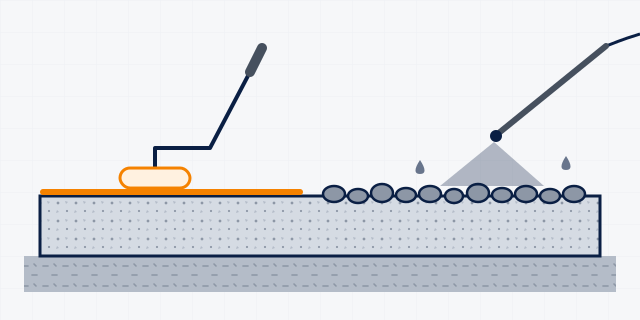
Exposed (washed) aggregate gives slip-resistant, decorative paving, walls and panels, and a rough key at construction joints. A surface retarder stops the top layer from setting so it can be washed off to reveal the stone.
- 7 steps
- 1 products
- 4 answers
You need this when…
- Architect wants a washed-gravel or pebble finish
- Smooth concrete paving is slippery when wet
- Construction joints need a rough key without hacking
- Precast panels need a decorative face
The work, step by step
General guidance based on the manufacturer data sheets. Site conditions differ: confirm the system with MCT before you start. Where we do not name a product, ask us and we will confirm the right one.
-
Step 1: Get the concrete right
A good exposed finish needs well-graded aggregate and good placing and compaction (Sika Rugasol-2 W Liquid p.2). Make site trials to set the dilution and timing, especially in changing temperatures (p.2).
-
Step 2: Dilute the retarder
Dilute with clean water at 1:1 to 3:1 depending on the depth of exposure required (Sika Rugasol-2 W Liquid p.2).
Sika Rugasol-2 W Liquid Sika Request a quotation -
Step 3: Horizontal surfaces: apply on the fresh concrete
Let the surface water evaporate for ½ to 2 hours, then apply an even coat by brush, roller or sprayer (Sika Rugasol-2 W Liquid p.2). Protect from rain and frost, and from sun and wind to stop rapid drying (p.2).
Sika Rugasol-2 W Liquid is used again here; data and quotation in step 2. Go to step 2
-
Step 4: Precast and walls: coat the formwork
Apply only to thoroughly clean formwork and cast within 48 hours (Sika Rugasol-2 W Liquid p.2). New, rough or very absorbent timber may need two coats; clean re-used formwork thoroughly (p.2).
Sika Rugasol-2 W Liquid is used again here; data and quotation in step 2. Go to step 2
-
Step 5: Wash off at the right time
When the main concrete is strong enough, wash off the retarded layer with a water jet, using a brush if needed. On formed faces, strike the formwork as soon as possible and wash (Sika Rugasol-2 W Liquid p.2). Hot weather greatly shortens the striking time (p.2).
-
Step 6: Cure normally
Rugasol is not a curing agent. Carry out normal curing, but do not water-cure until the retarded concrete has been removed (Sika Rugasol-2 W Liquid p.2).
-
Step 7: Optional water-repellent finish
On exposed walls and facades at least 4 weeks old, Sikagard-700 S PK is a colourless water-repellent impregnation for concrete (p.1, p.2). Repair cracks wider than 0.2 mm first (p.2).
Product for this stepAsk us The right product here depends on your site. We confirm it before naming it.
Proposal brief
Exposed aggregate finish: scope and system
A starting point for a site proposal. Quantities, prices and the final specification follow a site visit or photos.
Scope of work
- Trial panel to set dilution, timing and finish
- Supply of surface retarder
- Washing and curing method statement
- Optional water-repellent treatment
System build-up
| Step | Product | Pack | Source |
|---|---|---|---|
| 2. Dilute the retarder | Sika Rugasol-2 W Liquid | — | TDS p.1 · July 2021, Version 01.01 |
| 3. Horizontal surfaces: apply on the fresh concrete | Sika Rugasol-2 W Liquid | — | TDS p.1 · July 2021, Version 01.01 |
| 4. Precast and walls: coat the formwork | Sika Rugasol-2 W Liquid | — | TDS p.1 · July 2021, Version 01.01 |
What we need from you
- Area (m²) and whether paving, walls or precast panels
- Aggregate type and size wanted in the finish
- Photos or samples of the finish the client likes
- Pouring schedule and weather window
Site conditions
- Trial panel approved before production (Sika Rugasol-2 W Liquid p.2)
- Water supply and pressure washer on site
Not included
- Concrete supply and placing
- Formwork
Questions customers ask
How much retarder do I need?
About 0.1–0.2 kg per m², depending on dilution and the absorbency of the formwork (Sika Rugasol-2 W Liquid p.2).
Can I use it at construction joints?
Yes. It is listed for a rough key at construction joints (Sika Rugasol-2 W Liquid p.1).
Why did nothing wash off?
Usually timing or weather: heat shortens striking time, and the coat must be protected from sun and wind (Sika Rugasol-2 W Liquid p.2). Do a trial panel to set the timing.
Can I water-cure straight away?
No. Do not use water curing until the retarded concrete has been removed (Sika Rugasol-2 W Liquid p.2).
Steps and product facts are taken from the manufacturer data sheets (page cited). Products are named only where the data sheet confirms the use; quantities follow a site visit or photos. General guidance: check the data sheet or ask us before you start.