

For most types of non-structural concrete and cementitious mortars which need to reduce the incidence of shrinkage cracking: Ground bearing slabs, Screeds and overlays, Renders and plasters, Precast concrete elements, Sprayed applications, Extruded concrete. (TDS p.1)
Step-by-step solution
Concrete curing
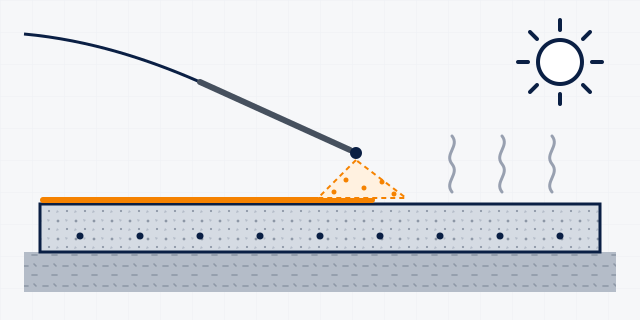
Curing keeps water in young concrete so it gains strength and does not crack or dust. In Pakistan's heat and dry wind it must start within minutes of finishing, by wet curing or a sprayed curing compound.
- 7 steps
- 4 products
- 4 answers
You need this when…
- Fine plastic shrinkage cracks on new slabs
- Dusty, weak floor surface
- Crazing on screeds and toppings
- Site cubes or cores weaker than expected
The work, step by step
General guidance based on the manufacturer data sheets. Site conditions differ: confirm the system with MCT before you start. Where we do not name a product, ask us and we will confirm the right one.
-
Step 1: Plan curing before the pour
Fresh concrete must be cured properly, especially at high temperatures, to prevent plastic and drying shrinkage; a curing compound or wet hessian are both accepted (Sika Plastiment-150 PK p.2). Decide now whether the slab will later get tiles, resin or paint, because film-forming compounds must then be removed (Sikafloor ProSeal W p.2).
-
Step 2: Reduce early cracking in the mix
Sika Crackstop Fiber 6 mm reduces plastic and drying shrinkage cracking (p.1); 600 g per m³ is the usual dose (p.2).
Sika Crackstop Fiber 6 mm Sika Request a quotation -
Step 3: Spray a curing compound on slabs
Apply immediately after finishing as a continuous, even film by low-pressure sprayer; a second coat is recommended once the first is tack free (Sikafloor ProSeal W p.3). ProSeal W is water-based for indoor areas where solvents are not allowed (p.1); ProSeal-22 is solvent-based and quick drying (Sikafloor ProSeal-22 p.1).
Sikafloor ProSeal W Sika Professionals only Request a quotation Sikafloor® ProSeal W is used for optimum curing and sealing of fresh concrete floors and structures. (TDS p.1)
- Temperature stated in TDS
- +10 °C min. / +30 °C max (TDS p.2)
Sikafloor ProSeal-22 Sika Professionals only Request a quotation Sikafloor® ProSeal-22 is used for optimum curing and sealing of fresh concrete Floors and structures Curing compound in order to limit surface drying and cracking Provides curing and sealing for Sikafloor® dry shake hardeners Anti-dust treatment and improve… (TDS p.1)
- Temperature stated in TDS
- +10 °C min. / +30 °C max (TDS p.2)
- Pack
- 25 l pails and 200 l drums.
-
Step 4: Cure, harden and dust-proof in one step
Sikafloor CureHard-24 cures, hardens and seals fresh or hardened concrete (p.1). On fresh concrete, spray as soon as the surface can be walked on and keep it wet for at least 30 minutes, then rinse off the excess (p.3). Use it as a curing compound only where no specific curing standard is specified (p.1, p.3).
Sikafloor CureHard-24 Sika Professionals only Horizontal old or new concrete surfaces, where a hard surface with light to moderate abrasion resistance is required e.g. (TDS p.1)
- Temperature stated in TDS
- +5 °C min. / +35 °C max (TDS p.2)
-
Step 5: Walls, columns and grouts
Cover with polythene sheeting or wet hessian; on grouts, do not start fogging until final set (SikaGrout-114 PK p.3).
-
Step 6: Respect the weather limits
Curing compounds are applied at +10 °C to +30 °C and up to 80 % relative humidity, and stored in a cool place above +25 °C (Sikafloor ProSeal W p.2). Outside these limits use wet curing.
-
Step 7: Remove before coatings
ProSeal W must be removed before a coating system (Sikafloor ProSeal W p.2); ProSeal-22 must be removed mechanically (Sikafloor ProSeal-22 p.2); CureHard-24 needs light to heavy shot blasting before coating (Sikafloor CureHard-24 p.3).
Proposal brief
Concrete curing: scope and system
A starting point for a site proposal. Quantities, prices and the final specification follow a site visit or photos.
Scope of work
- Curing method plan for slabs, walls and grouts
- Supply of curing compound or cure-and-harden treatment
- Spray application on slabs by a trained applicator
- Removal advice before later coatings
System build-up
| Step | Product | Pack | Source |
|---|---|---|---|
| 2. Reduce early cracking in the mix | Sika Crackstop Fiber 6 mm | — | TDS p.1 · November 2025, Version 02.02 |
| 3. Spray a curing compound on slabs | Sikafloor ProSeal W (professionals) | — | TDS p.1 · May 2021, Version 01.01 |
| 3. Spray a curing compound on slabs | Sikafloor ProSeal-22 (professionals) | 25 l pails and 200 l drums. | TDS p.1 · May 2021, Version 02.01 |
| 4. Cure, harden and dust-proof in one step | Sikafloor CureHard-24 (professionals) | — | TDS p.1 · May 2021, Version 01.01 |
What we need from you
- Area and type of concrete to cure (slab, deck, walls)
- Indoor or outdoor; any solvent restrictions
- Planned finishes on top (tiles, epoxy, paint, none)
- Pour dates and expected weather
Site conditions
- Application starts immediately after finishing (Sikafloor ProSeal W p.3)
- Air and substrate between +10 °C and +30 °C for curing compounds (Sikafloor ProSeal W p.2)
Not included
- Water supply, hessian and polythene for wet curing
- Removal of curing membranes before later coatings
Questions customers ask
When can people walk on a slab sprayed with ProSeal-22?
About 3 hours at +20 °C substrate temperature (Sikafloor ProSeal-22 p.2).
Can I tile or paint over a cured slab?
Only after removing the curing film: ProSeal-22 must be removed mechanically (Sikafloor ProSeal-22 p.2), and CureHard-24 needs shot blasting before coating (Sikafloor CureHard-24 p.3).
Is water curing better than a compound?
Both are accepted: the admixture data sheets call for a curing compound or wet hessian (Sika Plastiment-150 PK p.2). The choice depends on the element and site. Ask us: it depends on site conditions.
My new floor is already dusty. Can it still be treated?
Yes. CureHard-24 is used on old or new horizontal concrete to reduce dusting (Sikafloor CureHard-24 p.1). It will not make up for poor concrete with low cement content (p.3).
Steps and product facts are taken from the manufacturer data sheets (page cited). Products are named only where the data sheet confirms the use; quantities follow a site visit or photos. General guidance: check the data sheet or ask us before you start.