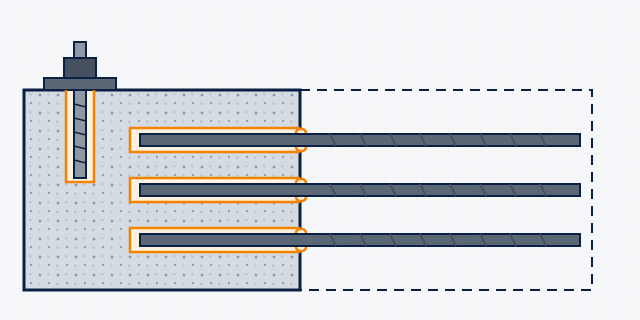
You need this when…
- New slab, beam or column to be connected to existing concrete
- Railings, balustrades or brackets coming loose
- Holding-down bolts needed for steel structures or machines
- Expansion anchors cracking the concrete near edges
The work, step by step
General guidance based on the manufacturer data sheets. Site conditions differ: confirm the system with MCT before you start. Where we do not name a product, ask us and we will confirm the right one.
-
1
Step 1: Engineer's design and base check
Anchor size, depth and spacing follow the design documentation (Sika AnchorFix-1 p.3). Confirm the strength of the concrete or masonry by testing (Sika AnchorFix-3001 p.3); if it is unknown, carry out pull-out tests (Sika AnchorFix-1 p.3).
-
2
Step 2: Choose the adhesive
General fixings in uncracked concrete and masonry: Sika AnchorFix-1, fast curing, with ETA for uncracked concrete and solid and hollow masonry (p.1). Structural rebar and cracked concrete: Sika AnchorFix-3001 (seismic C1, rebar connections) or AnchorFix-3030 (seismic C1 and C2, fire resistant) (p.1). Sika AnchorFix-2 has an evaluation for static, wind and earthquake loading (p.1).
As a fast curing anchoring adhesive for all grades of: Rebars / reinforcing steel, Threaded rods, Bolts and special fastening systems In the following substrates:, Concrete, Hollow and solid masonry, Hard natural stone*. (TDS p.1)
- Temperature stated in TDS
- -40 °C min. / +50 °C max (TDS p.2)
Anchoring adhesive for fixing of non-expanding anchors in the following: Structural work Rebar / steel reinforcement anchoring in new and refurbishment works Threaded rods Bolts and special fastening / fixing systems Metalwork, carpentry Handrails, balustra… (TDS p.1)
- Temperature stated in TDS
- -40 °C min. / +40 °C max (TDS p.2)
- Pack
- 400 ml side by side cartridge
Sika AnchorFix-3030 Sika
Professionals only Request a quotation
Anchoring adhesive for fixing of non-expanding anchors in the following: Structural work Rebar / steel reinforcement anchoring in new and refurbishment works Threaded rods Bolts and special fastening / fixing systems Metalwork, carpentry Handrails, balustra… (TDS p.1)
- Temperature stated in TDS
- -40 °C min. / +50 °C max (TDS p.2)
- Pack
- 385 ml dual cartridge
As a fast curing anchoring adhesive for all grades of: Rebars / reinforcing steel, Threaded rods, Bolts and special fastening systems In the following substrates:, Concrete, Solid masonry, Steel. (TDS p.1)
- Temperature stated in TDS
- 5 °C min. / +35 °C max (TDS p.2)
- Pack
- 300 ml standard cartridge 550 ml standard cartridge 12 cartridges per box pallet: 75…
-
3
Step 3: Drill and clean the hole
Drill to the design diameter and depth. Blow out from the bottom with oil-free compressed air at least twice, brush at least twice with a steel brush larger than the hole, and repeat until the return air is free of dust (Sika AnchorFix-3001 p.4).
-
4
Step 4: Inject the adhesive
Pump and discard the first extrusion until both parts come out in one even colour, then fill from the bottom while slowly withdrawing the mixer, avoiding air pockets (Sika AnchorFix-3001 p.4, p.5).
-
5
Step 5: Insert and leave undisturbed
Insert the clean rod or bar with a twisting motion within the open time; some adhesive should come out of the hole. Do not move or load the anchor while it hardens (Sika AnchorFix-1 p.5).
-
6
Step 6: Check temperatures and curing time
AnchorFix-1 must be at +5 °C to +40 °C when applied, and the substrate at least 3 °C above dew point (p.2). Curing time depends on substrate temperature (Sika AnchorFix-3001 p.3).
-
7
Step 7: Trial and proof-test
On natural stone or rock, try a sample area first for bond strength and staining (Sika AnchorFix-3001 p.3). Proof-test anchors where the design requires it.
Proposal brief
Chemical anchors, rebar & dowels: scope and system
A starting point for a site proposal. Quantities, prices and the final specification follow a site visit or photos.
Scope of work
- Review of the engineer's anchor or rebar design
- Drilling, hole cleaning and adhesive injection
- Installation of rods or bars
- Pull-out or proof testing where required
- Installation record per anchor
System build-up
| Step | Product | Pack | Source |
|---|
| 2. Choose the adhesive | Sika AnchorFix-1 | — | TDS p.1 · May 2021, Version 02.01 |
| 2. Choose the adhesive | Sika AnchorFix-3001 (professionals) | 400 ml side by side cartridge | TDS p.1 · March 2024, Version 04.01 |
| 2. Choose the adhesive | Sika AnchorFix-3030 (professionals) | 385 ml dual cartridge | TDS p.1 · March 2024, Version 02.01 |
| 2. Choose the adhesive | Sika AnchorFix-2 (professionals) | 300 ml standard cartridge 550 ml standard cartridge 12 cartridges per box pallet: 75… | TDS p.1 · May 2021, Version 01.01 |
What we need from you
- Engineer's drawings: bar or rod size, embedment, spacing, edge distance
- Base material: concrete grade, masonry type, cracked or uncracked
- Number of anchors or bars
- Access and working height
- Any drinking-water or fire-rating requirement
Site conditions
- Substrate strength confirmed by testing (Sika AnchorFix-3001 p.3)
- Application temperatures within the TDS limits (Sika AnchorFix-1 p.2)
Not included
- Structural design and calculations
- Rebar scanning and coring (quoted separately)
- Supply of steel bars and rods
Questions customers ask
Which adhesive for a seismic rebar connection?
AnchorFix-3030 is seismic tested C1 and C2 with ETA for post-installed rebar (p.1); AnchorFix-3001 is C1 tested (p.1). The engineer specifies the category.
Can I anchor into a hollow block wall?
Yes. AnchorFix-1 has ETA for anchoring in hollow masonry, installed with perforated sleeves (Sika AnchorFix-1 p.1, p.6).
Can I inject into a damp hole?
AnchorFix-3001 and -3030 can be used in damp concrete (p.1). AnchorFix-1 needs a clean, dry hole (p.3).
Can it be used inside a water tank?
AnchorFix-3001 and -3030 are stated as suitable for contact with drinking water (p.1), and AnchorFix-2 is drinking-water certified (p.1).
How long before I can load the anchor?
Ask us: it depends on site conditions. Curing time depends on substrate temperature (Sika AnchorFix-3001 p.3).
Steps and product facts are taken from the manufacturer data sheets (page cited). Products are named only where the data sheet confirms the use; quantities follow a site visit or photos. General guidance: check the data sheet or ask us before you start.