

Skip to content
Step-by-step solution

Hot-weather concreting

In a Pakistani summer, concrete loses slump in the truck, sets before it is finished and cracks if it dries early. Use a hot-climate superplasticiser or retarder, pour in the cooler hours and start curing straight away.

  • 6 steps
  • 6 products
  • 5 answers
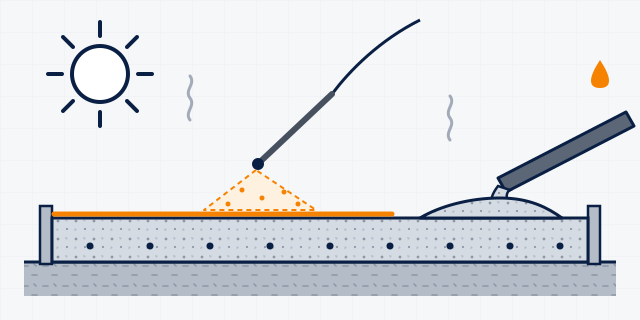
Concrete slab poured under a hot sun from a chute, with an admixture drop and a curing spray coating the finished part

Get this solution priced Proposal brief ↓

You need this when…

  • Slump lost before the transit mixer reaches site
  • Cold joints because the previous layer has already set
  • Fine plastic shrinkage cracks on slabs within hours of finishing
  • Mistri adding water on site to make the concrete workable again

The work, step by step

General guidance based on the manufacturer data sheets. Site conditions differ: confirm the system with MCT before you start. Where we do not name a product, ask us and we will confirm the right one.

  1. Step 1: Design and trial the mix

    Design the mix for the local cement and aggregates and run trial mixes before the job; suitability tests on the fresh concrete are required before pouring (Sika Plastiment-150 PK p.2). Do not add water on site to recover slump: excess water with a superplasticiser causes bleeding and segregation (Sika ViscoCrete-58 HT-PK p.2). Plan large pours for early morning or night.

  2. Step 2: Choose a hot-climate superplasticiser

    For ready-mix and long hauls use a slump-retaining superplasticiser made for hot and tropical conditions (Sikament R4QV PK p.1; Sika ViscoCrete-3110 star PK p.1; Sikament HRM Star PK p.1). Sikament RB 918 keeps rheoplastic concrete workable for more than 2 hours at +25 °C (Sikament RB 918 p.2). Guide dosage for Sikament R4QV PK is 0.8–3 % of binder (p.2); confirm by trial.

  3. Step 3: Add retardation for long hauls and big pours

    A set retarder prevents a sudden rise in concrete temperature during setting and keeps concrete workable through traffic delays (Sika Plastiretard TM 100 C2 WR PK p.1). Dose 0.2–2 % of cement; trial mixes are mandatory outside that range (p.2). Sika Plastiment-150 PK is a water-reducing retarder for high-temperature concreting at 0.3–0.8 % of binder (p.1, p.2).

    Sika Plastiretard TM 100 C2 WR PK Sika Request a quotation

    Concreting in Hot Weather Plastiretard provides an effective set-retarding action that prevents a sudden rise in concrete temperature during setting. Its use becomes particularly essential: When ambient temperatures are high, In large-mass concreting works such as dams and other massive structure… (TDS p.1)

    Pack
    05 ltr jerry can
    Sika Plastiment-150 PK Sika Request a quotation

    Sika® Plastiment®-150 PK is used for producing high quality concrete in applications such as: Ready mixed concrete, Fair faced concrete, High temperature concreting, Difficult placing conditions, Long transportation distances. (TDS p.1)

    Pack
    05 ltr jerry can
  4. Step 4: Batch correctly at the plant

    Add the admixture with the gauging water, never onto the dry mix. Mix wet for at least 60 seconds and add the remaining water only after two-thirds of the mixing time (Sikament R4QV PK p.2). Do not combine polycarboxylate superplasticisers with naphthalene-based admixtures (Sika ViscoCrete-58 HT-PK p.3).

  5. Step 5: Place, compact and reduce early cracking

    Extended workability puts more pressure on formwork, so make sure it is properly installed and secured (Sika Plastiment-150 PK p.2). In slabs and screeds, Sika Crackstop Fiber 6 mm reduces plastic and drying shrinkage cracking (p.1); 600 g per m³ is the usual dose (p.2).

    Product for this stepAsk us

    The right product here depends on your site. We confirm it before naming it.

  6. Step 6: Cure immediately

    Fresh concrete must be cured properly, especially at high temperatures, using a curing compound or wet hessian (Sika Plastiment-150 PK p.2). On slabs, spray a curing compound immediately after finishing (Sikafloor ProSeal W p.3). These compounds are applied at +10 °C to +30 °C and stored in a cool place above +25 °C (Sikafloor ProSeal W p.2), so spray in the cooler hours or use wet hessian and polythene.

    Product for this stepAsk us

    The right product here depends on your site. We confirm it before naming it.

Proposal brief

Hot-weather concreting: scope and system

A starting point for a site proposal. Quantities, prices and the final specification follow a site visit or photos.

Scope of work

  1. Review of the mix design and trial mixes with site or plant materials
  2. Supply of hot-climate superplasticiser and/or set retarder
  3. Dosing and batching guidance for the plant or site mixer
  4. Supply of curing compound and fibres for slabs
  5. Hot-weather placing and curing checklist for the site team

System build-up

StepProductPackSource
2. Choose a hot-climate superplasticiserSikament R4QV PK05 ltr jerry canTDS p.1 · June 2025, Version 02.01
2. Choose a hot-climate superplasticiserSika ViscoCrete-3110 star PK05 ltr jerry canTDS p.1 · January 2026, Version 01.01
2. Choose a hot-climate superplasticiserSikament RB 91805 ltr jerry can 20 ltr plastic can 235 ltr drum 1000 ltr IBC Bulk supply in tanker is…TDS p.1 · June 2025, Version 03.01
2. Choose a hot-climate superplasticiserSikament HRM Star PK05 ltr jerry canTDS p.1 · June 2025, Version 03.01
3. Add retardation for long hauls and big poursSika Plastiretard TM 100 C2 WR PK05 ltr jerry canTDS p.1 · August 2026, Version 01.01
3. Add retardation for long hauls and big poursSika Plastiment-150 PK05 ltr jerry canTDS p.1 · June 2025, Version 02.01

What we need from you

  • Concrete grade and slump required at the point of placing
  • Cement type and brand, aggregates, and any fly ash or slag
  • Haul time from plant to site and pour volumes
  • Planned pour times and expected air temperature
  • Element types: slab, raft, columns, walls

Site conditions

  • Trial mixes approved before full production (Sika Plastiment-150 PK p.2)
  • Curing starts immediately after finishing (Sikafloor ProSeal W p.3)
  • Curing compound applied between +10 °C and +30 °C (Sikafloor ProSeal W p.2)

Not included

  • Concrete supply, pumping and placing
  • Structural design and mix approval by the client's engineer
  • Chilling of water or aggregates at the plant

Questions customers ask

Can the mistri just add more water when the concrete stiffens?

No. Excess water with a superplasticiser causes bleeding or segregation (Sika ViscoCrete-58 HT-PK p.2). Use a slump-retaining admixture so the concrete stays workable without extra water (Sikament R4QV PK p.1).

How long will the concrete stay workable?

Sikament RB 918 keeps rheoplastic concrete workable for more than 2 hours at +25 °C; the loss depends on temperature, cement, aggregates and transport (Sikament RB 918 p.2). Confirm with a trial at your plant.

Will a retarder reduce the final strength?

No. The TDS states that Plastiretard improves mechanical strength development and reduces shrinkage and creep (Sika Plastiretard TM 100 C2 WR PK p.1). Overdosing extends setting, so keep the concrete moist during that time (Sika Plastiment-150 PK p.2).

Which curing method works in peak summer heat?

The curing compounds on file are applied at +10 °C to +30 °C (Sikafloor ProSeal W p.2; Sikafloor ProSeal-22 p.2). In hotter hours use wet hessian and polythene, which the admixture data sheets also accept (Sika Plastiment-150 PK p.2).

Do fibres replace curing?

No. Crackstop fibres reduce the tendency for plastic and drying shrinkage cracking (Sika Crackstop Fiber 6 mm p.1), but the concrete must still be cured (Sika Plastiment-150 PK p.2).

Steps and product facts are taken from the manufacturer data sheets (page cited). Products are named only where the data sheet confirms the use; quantities follow a site visit or photos. General guidance: check the data sheet or ask us before you start.